
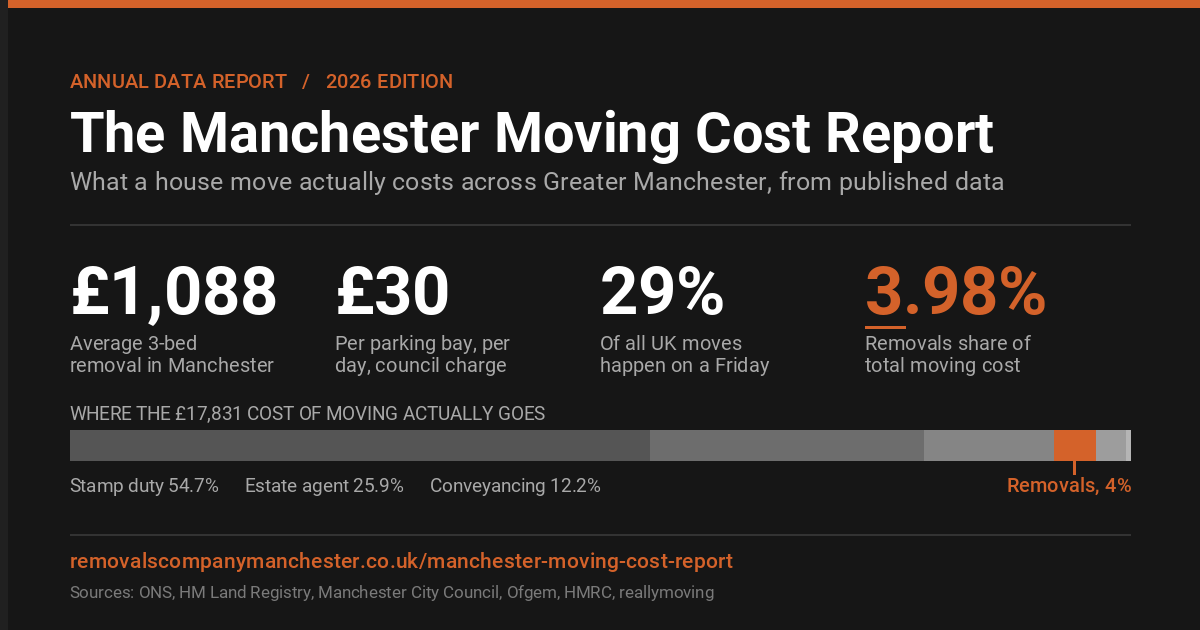
This is an annual reference report on what it actually costs to move home in Greater Manchester, published by Removals Company Manchester. It is built entirely from publicly available data: the Office for National Statistics and HM Land Registry UK House Price Index, Manchester City Council’s published charging schedules, Ministry of Housing, Communities and Local Government (MHCLG) council tax statistics, the Office of Gas and Electricity Markets (Ofgem) price cap, Royal Mail’s published tariffs, His Majesty’s Revenue and Customs (HMRC) stamp duty thresholds, and removal cost datasets published by Compare My Move, reallymoving, HomeOwners Alliance and Konnect You.
Every figure below is traceable to a named source with a date. Where a number is derived rather than observed, the derivation is shown and labelled. Nothing here is a quote, and nothing here is modelled from private company data.
Key findings at a glance
- A 3-bed Manchester removal averages £1,088. The observed local range across all property sizes runs from £302 to £2,630 (Compare My Move, May 2026).
- The removal van is under 4% of what it costs to move house. reallymoving’s analysis of 181,000 mover quotes put total buyer-and-seller costs at £17,831, of which removals were £709.
- Distance barely matters inside Greater Manchester. The county’s widest internal span is roughly 30 miles, below the 50-mile point at which national datasets begin applying a long-distance uplift. Access time, not mileage, drives intra-county price variation.
- Friday carries 29% of all UK moves. That is 2.03 times an even seven-day distribution. Sunday carries 5%.
- Manchester City Council charges £30 per day per bay to suspend an on-street parking bay for a domestic removal, with a minimum five working days notice.
- The average Manchester home sits below the first-time buyer stamp duty threshold. A first-time buyer at Manchester’s £247,000 average pays £0. The same buyer at the £335,000 Great Britain average pays £1,750.
How this report was built, and what its limits are
Three categories of source are used, and they behave differently. Understanding the difference is the single most useful thing in this report, because it explains why published Manchester removal figures contradict each other so badly.
| Source type | What it measures | Named sources used here | Known bias |
|---|---|---|---|
| Statutory and regulated | Prices set in law or by a regulator | Manchester City Council, MHCLG, Ofgem, HMRC, Royal Mail | None. These are the exact charges. |
| Official statistics | Transaction values recorded at registration | ONS and HM Land Registry UK House Price Index | Provisional figures revise. Registration lags completion. |
| Comparison platform data | Quotes requested, or prices paid, by platform users | Compare My Move, reallymoving, HomeOwners Alliance, Konnect You | Self-selected users. Distance and service assumptions differ by platform and are often unstated. |
The third category is where the contradictions live. A platform that samples quotes for a fixed 10-mile move will produce a different average to one that samples prices actually paid across all distances over a four-year window. Neither is wrong. They are not the same measurement, and they should never be quoted side by side as if they were.
This report presents both, labelled, rather than picking the flattering one.
Greater Manchester removal costs by property size
| Property size | Manchester average | UK average, paid moves | UK average, 10-mile quotes | Basis |
|---|---|---|---|---|
| 1 bedroom | £385 | Not published separately | Not published separately | Observed |
| 2 bedrooms | £636 | £834 | £603 | Observed |
| 3 bedrooms | £1,088 | £1,252 | £867 | Observed |
| 4 bedrooms | £1,652 | Not published separately | Not published separately | Observed |
| 5 bedrooms | £2,150 to £2,600 (derived) | Not published separately | Not published separately | Derived, see note |
Manchester and paid-move columns: Compare My Move, Manchester removal cost data, May 2026, and Konnect You verified moves 2022 to 2026. Quote column: HomeOwners Alliance with reallymoving, average removal cost for a 10-mile move, January 2026.
These bands describe a standard house removal in Manchester with the household packing its own boxes. Moves at or below the 1-bed figure are usually better served by a smaller van and crew, and adding a professional packing service sits outside these figures entirely.
Why the 5-bed figure is derived rather than observed
No public dataset publishes a Manchester-specific 5-bed removal average. Rather than leave the row blank or borrow a national number and relabel it, this report derives a range from the step ratios inside Manchester’s own observed series.
The size-to-size multipliers in the Manchester data are 1.65 (1-bed to 2-bed), 1.71 (2-bed to 3-bed) and 1.52 (3-bed to 4-bed). The multiplier is decelerating as properties get larger, which is expected: crew and vehicle capacity scale in steps rather than smoothly. Continuing that deceleration gives a 4-bed to 5-bed multiplier of roughly 1.30 to 1.57, applied to the observed £1,652 4-bed average. That produces £2,150 to £2,600.
The upper end of that range sits close to the £2,630 top of the observed 4-bed spread, which is a useful sanity check: the most expensive 4-bed moves in Manchester already cost what a typical 5-bed move should. Treat this row as an informed estimate, not a measurement.
Local, cross-city and long-distance pricing in Greater Manchester
This is the most commonly misunderstood line in any Manchester removal quote. Movers routinely expect a Wythenshawe to Prestwich move to cost meaningfully more than a Chorlton to Didsbury move because it is four times the distance. In practice the difference is small, because the van is not on the road four times as long. It is a single-day job either way, and the driving is a minor share of the crew’s hours.
| Band | Worked Manchester example | Approx. road distance | Typical uplift on local baseline | What actually drives the price |
|---|---|---|---|---|
| Intra-suburb | Chorlton to Didsbury | 3 miles | Baseline | Loading time, stairs, kerb access |
| Cross-city | Levenshulme to Salford Quays | 7 miles | Negligible on distance alone | Lift booking, loading bay restrictions |
| Cross-borough | Wythenshawe to Prestwich | 13 miles | Negligible on distance alone | Peak-hour routing across the city core |
| County edge to edge | Wigan to Stalybridge | 30 miles | Still under the 50-mile threshold | Crew hours, single-day feasibility |
| Regional | Manchester to Leeds | 45 miles | 30% to 50% | Return journey, fuel, driver hours |
| Long-distance | Manchester to London | 200 miles | 50% to 80% | Overnight, two-day crewing, tolls |
Uplift percentages: MovingCost.co.uk (30% to 50% above 50 miles, June 2026) and MovingCalculator (50% to 80% above 100 miles, March 2026). A third source, Sirelo, puts the same gap at 73% for a 3-bed, moving from £1,020 local to £1,770 long-distance. Distances are approximate road distances.
The access variable that national datasets cannot see
Compare My Move’s Manchester analysis notes that around 40% of Manchester moves are flats, and states plainly that the difficult part of a Manchester move is rarely the drive. It is what happens when the van arrives.
Three specific Manchester conditions push a quote up without adding a single mile:
- City-centre bus gates. Oxford Road operates bus gates from 6am to 9pm daily, with automatic enforcement. A removal route that would ordinarily cross Oxford Road has to be re-planned, adding crew time.
- Terraced streets with no off-street parking. Large parts of Levenshulme, Longsight, Gorton and Rusholme are Victorian and Edwardian terraces where the nearest legal stopping point may be 30 metres or more from the front door. Carry distance is billed as time.
- Apartment blocks with booked service lifts. Ancoats, New Islington and Salford Quays blocks commonly require a lift booking slot. Miss the slot and the crew waits.
None of these appear in a national average. All of them appear on the invoice.
Seasonal and day-of-week pricing across the moving year
The concentration is the point. There are 2.2 million household moves in the UK each year, an average of around 6,000 a day, according to HomeOwners Alliance. Demand is not spread across that calendar evenly, and removal pricing responds to concentration rather than to volume.
Day-of-week distribution and the Friday premium
| Day | Share of UK moves | Against an even 14.3% share | Practical effect on price and risk |
|---|---|---|---|
| Friday | 29% | 2.03x concentration | Least negotiable day. Highest delay exposure. |
| Saturday | 16% | 1.12x | Popular but not a completion day for most chains. |
| Monday | 15% | 1.05x | Full working week ahead to resolve problems. |
| Tuesday | 10% | 0.70x | Genuine negotiating room on price. |
| Sunday | 5% | 0.35x | Cheapest average move. Cannot be a completion day. |
Shares: reallymoving removals quote data, 750,000+ quotes, via HomeOwners Alliance, 2026. Wednesday and Thursday are not separately published in the source and are omitted rather than estimated. Concentration column is this report’s calculation: stated share divided by 14.29%, an even seven-day distribution.
Compare My Move’s separate dataset of over 170,000 removals puts Friday at just over 28%, corroborating the reallymoving figure from an independent sample. It also puts Sunday as the cheapest day to move, at an average of £717.13.
The Friday premium is not usually a published surcharge. It is an availability effect. reallymoving found that around one in five removal firms are willing to negotiate on price to shift movers to a quieter day, which means the discount exists but has to be asked for, and it is only available if the completion date allows it.
The August peak, and why it is riskier than it is expensive
| Period | Share of UK moves | Against an even 8.33% month |
|---|---|---|
| August | 12% | 1.44x concentration |
| July | 10% | 1.20x |
| September | 10% | 1.20x |
| Late summer and early autumn combined | 32% | Nearly a third of the year’s moves in a quarter |
| January and February | Consistently the quietest months | Best availability and negotiating position |
Source: HomeOwners Alliance and reallymoving analysis of removal quote data, 2026. Concentration column is this report’s calculation against a 1/12 even distribution.
The more useful finding about August is about failure, not price. In a reallymoving survey of removal firms, 85% said moving day delays are more likely on busy moving days. The firms named three causes:
- Delays in the transfer of funds by the conveyancer or the banking system on completion day, cited by 88% of firms
- Keys not released in time by the estate agent or seller, cited by 69%
- Delays elsewhere in the property chain creating a knock-on effect, cited by 67%
All three are worse on a Friday in August, and none of them are within the removal firm’s control. A household that books the cheapest possible slot on the busiest possible day has optimised for the wrong variable.
The administrative cost stack nobody quotes for
This is the section of the report with the least uncertainty in it, because these are not averages. They are the actual published charges.
Manchester council tax, and the overlap problem
Manchester City Council’s Band D charge for 2026/27 is £2,312.04, which sits below the England average Band D of £2,391.52. Because every other band is a fixed statutory fraction of Band D under the Local Government Finance Act 1992, the full ladder is fixed arithmetic.
| Band | Manchester annual charge 2026/27 | Cost per day of overlap |
|---|---|---|
| Band A | £1,541.36 | £4.22 |
| Band B | £1,798.25 | £4.93 |
| Band C | £2,055.15 | £5.63 |
| Band D | £2,312.04 | £6.33 |
| Band E | £2,825.83 | £7.74 |
| Band F | £3,339.61 | £9.15 |
| Band G | £3,853.40 | £10.56 |
| Band H | £4,624.08 | £12.67 |
Band D source: MHCLG, Council Tax levels set by local authorities in England 2026 to 2027, and Manchester City Council’s published 2026/27 schedule. Other bands are the statutory proportions of Band D. Daily figures are this report’s calculation, annual charge divided by 365.
Two Manchester-specific points follow from this table.
First, 55% of Manchester’s 249,190 domestic properties are Band A, according to Valuation Office Agency data. Manchester is not a Band D city. The Band D headline that every national comparison uses overstates what a typical Manchester household actually pays, and the MHCLG average council tax per dwelling for Manchester is £1,444.25, well below the Band D reference figure.
Second, moving up the ladder inside Manchester is expensive in a way that compounds annually. A Band A to Band D move costs an additional £770.68 every year for as long as you live there. That is more than most people’s entire removal quote, repeating, and it is almost never modelled at the point of choosing between two properties.
Energy standing charges during the handover window
Ofgem’s price cap for 1 July to 30 September 2026 sets the typical annual dual-fuel bill for a direct debit household at £1,663. That figure needs a caveat that most moving guides get wrong: it fell from a previously quoted £1,862 not because energy got cheaper but because Ofgem introduced new Total Domestic Consumption Values on 1 July 2026, changing the assumed usage that the headline is built on. Unit rates rose by 13%.
For a mover, the relevant number is not the annual cap. It is the standing charge, which accrues at both properties during any overlap regardless of whether anyone is using energy. The average dual-fuel direct debit standing charge runs at approximately £315 a year, which is £0.86 a day per property.
Address change and mail redirection
Royal Mail Redirection starts from £45.00 for three months per person, per its published tariff. Longer terms and multi-adult households cost more, and each adult at the address requires a separate redirection. Children under 16 can be added to a parent’s redirection at no charge. Concession rates from £22.50 are available to recipients of Universal Credit or Pension Credit.
Published figures for the 6-month and 12-month tiers vary between secondary sources, so this report cites only Royal Mail’s own stated entry price and directs readers to royalmail.com for current tier pricing. The important limitation, which is rarely stated: redirection forwards mail, it does not update your address with the sender, and it does not cover parcels carried by third-party couriers.
Manchester parking bay suspensions and yellow line dispensations
This is the most underreported cost in any Manchester move, and it comes straight from the council’s published schedule.
Manchester City Council will suspend an on-street pay and display bay for a domestic removal. Domestic removals are explicitly listed as an accepted reason alongside building operations, weddings, funerals and deliveries. The cost is £30 per day, per bay, and a minimum notice period of five working days is required for all applications. Failure to give that notice may result in delay or refusal.
The council also issues dispensations allowing a specified vehicle to park on single or double yellow lines during restricted hours, for a specific location and time. A certificate is issued and must be displayed clearly in the vehicle.
A Luton van typically occupies two bays. At both ends of a city-centre move, that is £120 for a single day. The five working day notice requirement is the part that catches people out, because completion dates frequently firm up later than that.
The worked administrative stack, two Manchester scenarios
| Line item | Band A terrace, driveway at new address | Band D home, on-street both ends |
|---|---|---|
| Council tax, 3-day overlap at old address | £12.66 | £18.99 |
| Energy standing charge, 3-day overlap | £2.58 | £2.58 |
| Royal Mail Redirection | £45.00 (3 months, one adult) | £108.50 (12 months, two adults) |
| Parking bay suspension | £60.00 (2 bays, one address) | £120.00 (2 bays, both addresses) |
| Total | £120.24 | £250.07 |
Both scenarios are this report’s calculation using the statutory and published charges cited above. The 12-month two-adult redirection figure is the most widely reported secondary figure and should be confirmed against royalmail.com at the time of booking.
Manchester against the UK national average
| Comparison | Manchester | UK figure | Difference |
|---|---|---|---|
| 2-bed vs paid moves 2022 to 2026 | £636 | £834 | 23.7% below |
| 3-bed vs paid moves 2022 to 2026 | £1,088 | £1,252 | 13.1% below |
| 2-bed vs 10-mile quotes | £636 | £603 | 5.5% above |
| 3-bed vs 10-mile quotes | £1,088 | £867 | 25.5% above |
Percentage differences are this report’s calculation from the underlying published figures cited earlier.
The reconciliation is straightforward once the denominators are visible. Paid-move datasets capture a large share of small, self-packed, flexible-date moves, which drags the average down and which Manchester has more of than most cities, given that around 40% of Manchester moves are flats. Fixed-distance quote datasets standardise the job and strip that mix effect out, which pushes Manchester up relative to the national picture because Manchester’s access conditions are worse than average even when the distance is held constant.
Both effects are real. Manchester genuinely has cheaper typical moves and genuinely has harder individual moves. That is not a contradiction, and it is the most accurate one-sentence summary of the Manchester removals market this report can offer.
Original analysis: the removal van is the smallest number on the page
reallymoving’s cost of moving analysis used quotes generated by 181,000 home movers and covered stamp duty, conveyancing, estate agent fees, a Level 2 Royal Institution of Chartered Surveyors (RICS) Homebuyer survey, an Energy Performance Certificate (EPC) and removals. On a median property of £395,000 the components were:
| Component | Cost | Share of total | Year-on-year change |
|---|---|---|---|
| Stamp duty | £9,750 | 54.7% | Driven up by threshold changes |
| Estate agent commission | £4,615 | 25.9% | Not separately stated |
| Conveyancing incl. disbursements | £2,182 | 12.2% | Up 8.7% |
| Removals | £709 | 3.98% | Up 1.5% |
| Survey | £510 | 2.9% | Up 6.5% |
| EPC | £65 | 0.4% | Unchanged |
| Total | £17,831 | 100% | Up 27%, or £3,786 |
Component costs from reallymoving’s analysis of 181,000 home mover quotes. Share-of-total column is this report’s calculation. reallymoving states these costs now consume 46% of the median annual salary in England.
Removals rose 1.5% year on year while conveyancing rose 8.7% and the overall cost of moving rose 27%. The removal company is the line item that has inflated least and the only one where shopping around materially changes what you pay, because conveyancing and agency fees are largely set by property value rather than by negotiation.
The Manchester stamp duty position, and why it favours first-time buyers
Applying current HMRC stamp duty thresholds to Manchester’s actual house prices produces a finding that national cost-of-moving guides miss entirely, because they model the national average price.
The average Manchester house price was £247,000 in May 2026 (provisional), according to the ONS and HM Land Registry UK House Price Index. Manchester home-movers specifically paid an average of £286,000. The Great Britain average was £335,000.
Stamp duty in England and Northern Ireland has been charged at 0% up to £125,000, 2% from £125,001 to £250,000 and 5% from £250,001 to £925,000 since 1 April 2025. First-time buyer relief gives 0% up to £300,000, then 5% to £500,000, with relief withdrawn above £500,000.
| Buyer and price point | Stamp duty due | Calculation |
|---|---|---|
| First-time buyer, Manchester average £247,000 | £0 | Entirely below the £300,000 relief threshold |
| First-time buyer, GB average £335,000 | £1,750 | 5% on £35,000 above £300,000 |
| Home mover, Manchester average £247,000 | £2,440 | 2% on £122,000 above £125,000 |
| Home mover, Manchester mover average £286,000 | £4,300 | £2,500 plus 5% on £36,000 |
| Home mover, GB average £335,000 | £6,750 | £2,500 plus 5% on £85,000 |
Stamp duty figures are this report’s calculation from published HMRC thresholds applied to ONS and HM Land Registry average prices, May 2026. Individual circumstances, surcharges and reliefs vary. This is not tax advice.
Two conclusions follow. A Manchester first-time buyer purchasing at the local average pays no stamp duty at all, while the equivalent buyer at the Great Britain average pays £1,750. And a Manchester home mover at the local average pays £4,310 less stamp duty than a home mover at the Great Britain average.
For a first-time buyer, that means removals are a far larger share of their total moving cost than the national picture suggests, because the largest national cost line has been zeroed out. reallymoving put first-time buyer removals at £432 against conveyancing of £1,421 and a survey fee of £462. In Manchester specifically, the removal quote is one of the biggest bills a first-time buyer will actually face.
When these figures do not apply
- Specialist items. Pianos, safes, gym equipment and large aquariums are priced separately from the property-size bands and can exceed the entire base quote for a small property. How those are assessed is covered on piano moving in Manchester.
- Properties with no vehicle access. If the nearest legal stopping point is more than roughly 50 metres from the door, or if access is via a rear alley only, the size-band averages stop being useful. This affects a meaningful share of inner Manchester terraced stock.
- Part-load and shared-van moves. These sit well below the ranges here and carry date flexibility requirements that most people in a chain cannot meet.
- Office and commercial relocations. Priced on a different basis entirely, usually by volume, out-of-hours requirements and IT disconnection, not bedroom count. See office removals in Manchester and business removals for that pricing basis.
- Moves with a gap between completion dates. Where the two dates do not align, the load has to go somewhere, and the cost shifts from a single removal to a removal plus a storage period. Self storage is priced by unit size and duration rather than by property size, so none of the bands above apply.
- Moves outside the ten Greater Manchester boroughs. The council tax figures, parking charges and access assumptions in this report are Manchester City Council’s. Neighbouring authorities set their own.
One further point that removal companies do not usually volunteer. If a quote comes in well below the ranges in this report, that is not automatically good news. The most common reason a Manchester quote is unusually low is that the surveyor has underestimated volume or has not seen the access conditions. Underquoted jobs tend to resolve on the day, in the customer’s disfavour, through extra hours or a second trip. A quote that sits inside the ranges here and is based on a video or in-person survey is a better outcome than a cheaper quote based on a phone call.
What the quoted bands actually buy
Our own service is structured in three levels, with two additions that sit outside them. The distinction matters for anyone using the bands above as a benchmark, because a figure quoted at one level is not comparable to a figure quoted at another.
- Standard. Loading and unloading. This is the level the cost bands in this report sit closest to, and the baseline most published removal averages describe.
- Standard Plus. Adds taking furniture apart and putting it back together, across the whole inventory rather than charged item by item. The difference shows up most on 3-bed and 4-bed moves, where bed frames, wardrobes and desks are the reason a job runs long.
- Premium. Adds professional packing, scoped to whatever you ask for. Some households hand over the entire property, others hand over the kitchen and the loft and keep the rest.
- Boxes on their own. Materials without labour, for anyone packing themselves who would rather not build a move around whatever cartons the local supermarket had going spare.
- Storage. A separate line rather than a package tier, covering the gap between completion dates that the administrative stack above does not.
The practical consequence for budgeting is this. When you collect three quotes and one comes back materially cheaper, check the level before concluding anything. A Standard quote sitting alongside two Premium quotes will always look like the bargain, and it is not the same job. See packing services, furniture dismantling and self storage in Manchester for what sits inside each, or man and van for jobs below the 1-bed band entirely.
Frequently asked questions
How much does it cost to move a 3-bed house in Manchester?
Is it cheaper to move house in Manchester than the rest of the UK?
What is the cheapest day to move house?
Do I need a parking permit for a removal van in Manchester?
Why is August the most expensive month to move?
What costs do people forget when budgeting for a move?
Citing and republishing this report
This report is published so that it can be quoted. Journalists, estate agents, mortgage advisers and property bloggers are welcome to reproduce any table or figure from this page, including in commercial publications, on two conditions: attribute the figure to The Manchester Moving Cost Report and link to this page, and where the underlying figure belongs to a third party such as the ONS, Ofgem or Manchester City Council, cite that original source as well.
Where a figure is this report’s own calculation rather than a lifted statistic, it is labelled as such in the note beneath each table. Please carry that distinction through into any republication.
Sources
- Office for National Statistics and HM Land Registry, UK House Price Index, Manchester local area data, May 2026 (provisional)
- Manchester City Council, Suspensions and dispensations, parking bay suspension and yellow line dispensation charges
- Ministry of Housing, Communities and Local Government, Council Tax levels set by local authorities in England, 2026 to 2027, Table 9
- Valuation Office Agency, council tax statistics, band distribution for Manchester
- Ofgem, energy price cap, default tariff levels, 1 July to 30 September 2026
- Royal Mail, Redirection, published tariff
- HM Revenue and Customs, Stamp Duty Land Tax residential rates, thresholds in force from 1 April 2025
- Compare My Move, Manchester removal cost data, May 2026, and best day to move analysis of 170,000+ removals
- reallymoving, cost of moving analysis of 181,000 home mover quotes, and removals quote data covering 750,000+ quotes
- HomeOwners Alliance, cost of moving calculator and busiest moving day analysis, 2026
- Konnect You, removal company cost data from verified moves 2022 to 2026
- MovingCost.co.uk and MovingCalculator, published long-distance uplift ranges, 2026
Related Manchester cost guides
This report is the top-level benchmark. The guides below go deeper on individual questions raised here:
- Removal costs for a 3-bed house in Manchester, with three worked scenarios including a Chorlton to Didsbury move
- House removal prices in Manchester versus the UK average, on the local factors behind the gap
- Best time of year to move house in Manchester, a month-by-month cost and availability breakdown
- Man and van costs in Manchester, for moves below the 2-bed threshold
- How to estimate your move before you book, on volume assessment and survey types
- Heavy and bulky item removals in Manchester, covering the specialist items excluded from the bands above
For the services these figures relate to, see house removals in Manchester and office removals in Manchester. Removals Company Manchester is the starting point for anything not covered above.
About this edition
This is the 2026 edition of The Manchester Moving Cost Report, published by Removals Company Manchester. It is updated annually, and the URL does not change between editions so that citations remain valid. Statutory charges quoted are those in force for the 2026/27 financial year. Removal cost data reflects the most recent published figures available at the time of writing in August 2026.
Corrections and data queries are welcome via the contact page. Where a figure in this report is shown to be wrong, it will be corrected and the correction noted here rather than quietly amended.