
Uprights, baby grands and full grands, across Greater Manchester. One item, considerable weight, and a route that has to be worked out before anybody lifts anything.
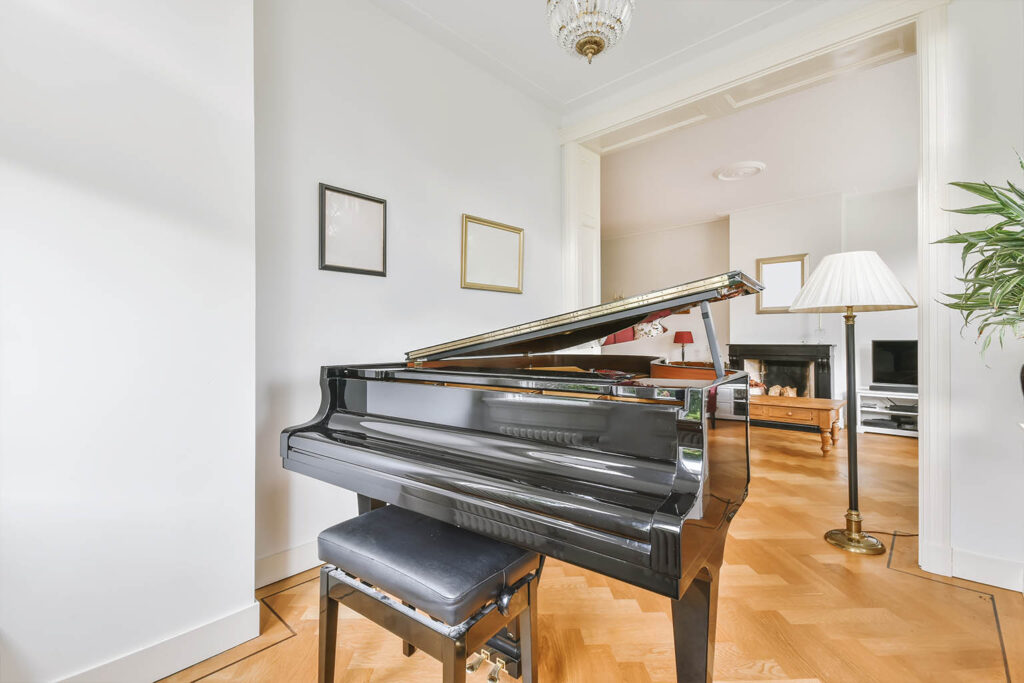
The short version. Send a photograph of the instrument and a description of the steps and doorways at both addresses. That is nearly always enough for a written figure.
People assume the difficulty with a piano is how heavy it is. Weight is a factor, but it is rarely the deciding one. What decides whether a piano move is straightforward or complicated is the route it has to travel, and specifically the tightest point on that route.
A heavy instrument on level ground with a wide doorway is a manageable job. A lighter one at the top of a narrow flight with a turn and a low ceiling above it is a considerably harder one. Two identical pianos in two different houses can be very different pieces of work, which is why we ask about steps and doorways before we ask about the make.
The other thing worth saying is that we would rather turn a job down or recommend a different approach than attempt something that should not be attempted. If a route genuinely will not take an instrument, saying so beforehand is far better than discovering it with three people committed and a piano halfway.
Six kinds of instrument, and the differences between them matter more than the categories suggest.
The most common by far, and the ones we move most weeks. Weights vary enormously between a small modern upright and an older overstrung instrument, so the make and rough age tell us more than the word upright does.
Shorter than a full grand and still a substantial job. The legs and lyre come off and the instrument travels on its side on a board, which is standard practice rather than anything unusual.
Larger, heavier and needing more people and more planning. These are the ones we most want to see beforehand, particularly where stairs or a turn are involved at either end.
Frequently far heavier than they look. Early twentieth century instruments with iron frames can weigh considerably more than a modern upright of the same height, which changes the crew rather than the method.
Much lighter and generally straightforward, though the better ones are heavier than people expect and the stands come apart separately.
Church and reed organs vary hugely and some come apart into sections. Worth a conversation rather than an assumption.
Six things, and the last one is more useful than people expect. How an instrument came into a room usually tells us how it can leave.
A photograph of the piano and the steps at both ends is usually all we need to price it.
A good share of the piano work we do is not part of a house move at all. Somebody has bought or been given an instrument and it needs collecting, and those jobs have a particular pattern worth knowing about.
The most common version is an inherited or free piano. A relative has died or moved into care, or somebody is clearing a house and wants the instrument to go somewhere it will be played. These are good outcomes and they are also the collections that most often go wrong, because nobody at the collection end can tell you anything useful about the instrument. It has simply always been there.
What helps is getting a photograph before the day, including the name on the fallboard and a view of the whole instrument from the side. That tells us a great deal about age, type and likely weight. A photograph of the route out is worth just as much.
The second thing to establish is whether anybody will be at the collection address and whether they can help. Frequently the answer is that a key is being left with a neighbour, which is workable as long as we know rather than discover it.
The last point is a difficult one and worth saying plainly. Free pianos are free for a reason often enough that it is worth having the instrument looked at before paying to move it. An older upright with a cracked frame or seized action can cost more to make playable than a decent second-hand instrument would cost outright, and moving it is money spent before that question is answered. If you can, get somebody who knows pianos to look at it, or at least send photographs to a tuner, before booking the move.
Almost every question about whether a piano can be moved comes down to one measurement somewhere on the route, and it is usually not the one people are worried about.
Steps in themselves are rarely the obstacle. A straight flight, however long, is a matter of people and time. What causes difficulty is a turn, because an instrument has to be rotated in a space that may not be large enough to rotate it in, and unlike furniture a piano cannot be tilted much without consequence.
Half landings are the classic example. A flight that turns through ninety degrees onto a small landing and then continues is considerably harder than a straight run of twice the length. The ceiling above that landing matters too, since it limits how far an instrument can be angled while it is being turned.
Doorways are the other pinch point, and the frame is what counts rather than the opening. Where an inch or two is missing, taking the door off its hinges frequently solves it, and occasionally the architrave can come off and be refitted. Both are far better answers than force.
Threshold steps catch people out because they are easy to overlook when describing a house. A single step up into a front door changes the approach for a heavy instrument, particularly where there is no room to set up properly on the outside of it.
The reason we ask how the piano got into the room originally is that it is the most reliable evidence available. If it came up a staircase twenty years ago, that staircase can take it. If it went in through a window, or arrived before an extension was built, that is worth knowing now.
Five things, and the first two account for most of the variation.
An upright and a full grand are different jobs in crew size, equipment and time. Within uprights, an older overstrung instrument can weigh half as much again as a modern one of the same height.
Steps are manageable and turns are the constraint. A straight flight is a very different proposition from one with a half landing, and the destination matters as much as the origin.
Level ground, a gravel drive, a flight of garden steps or forty metres of pavement. This is frequently a larger factor than the stairs inside the house.
Decided by the instrument and the route rather than chosen. We would rather send an extra pair of hands than attempt something short-handed.
A piano within a house removal is planned into the day. Booked on its own it is priced as its own visit, which for a single instrument is usually the sensible option.
Two things are worth knowing about the period after a piano arrives, and neither is about the move itself.
The first is tuning. Your piano will very probably need tuning after a move, and that is normal rather than a sign that something went wrong. Pianos respond to their environment, and a change of room means a change of temperature, humidity and acoustics. The instrument shifts in response to that far more than to the journey.
What is worth doing is waiting. Let the piano settle in its new room for two or three weeks before booking a tuner. Tuning it the same week means paying for a tuning that will drift as the instrument acclimatises, and most tuners will tell you the same thing.
The second is where it goes. This decision is worth making before moving day rather than after, because moving a piano twice inside a house is a second job.
Broadly, an internal wall is kinder than an external one, and away from a radiator is kinder than beside it. Direct sunlight through a window is worth avoiding, as is a spot next to a door that is opened to the outside constantly in winter. None of this is about the instrument being delicate so much as about stability, since what pianos dislike most is change rather than any particular condition.
If you are unsure, decide roughly where it is going before we arrive and we will put it there. Sliding a piano across a room afterwards is possible but it is not something to do casually on a wooden floor.
Across Greater Manchester and the surrounding areas, whether the piano is the whole job or one item within a house move. We also move instruments for schools, churches and venues as part of commercial work.
Where the piano is one item among a whole household.
If the instrument needs somewhere to wait between two dates.
For the other heavy things that need taking apart.
Pianos in schools, churches, halls and venues.
It depends on the instrument and the access at both ends, so we price each one rather than quoting a figure that would be wrong for most. Send us a photograph of the piano, the name on it if you can see one, and a description of the steps at both addresses.
For an upright with straightforward access, usually not, provided you can send photographs. For a grand, or where there are stairs, turns or an awkward approach at either end, we would much rather look first. It takes twenty minutes and it is the difference between a plan and an assumption.
Yes, that is how a grand is moved. The lyre and legs come off and the instrument travels on its side on a board. It is standard practice and it is put back together at the far end.
Almost certainly, and that is normal rather than a sign anything went wrong. Pianos go out of tune from the change in environment as much as from the journey, so it is worth letting the instrument settle in its new room for two to three weeks before booking a tuner rather than doing it the same week.
Often, and it depends entirely on the staircase rather than the weight. A straight flight is usually workable. A narrow flight with a turn and a low ceiling above it may not be, and we will tell you honestly at the quote stage rather than finding out halfway.
It can go into store, and the thing worth knowing is that pianos prefer stable conditions. Extremes of temperature and humidity are harder on an instrument than the move itself, so it is worth discussing the expected period before deciding.
Yes, and they are considerably easier. The better weighted instruments are heavier than people expect and the stand usually comes apart separately, but there is nothing unusual involved.
Yes, and it comes up more than you might think, usually because of building work or a new carpet. It is a short visit rather than a removal and it is priced accordingly.
Send a photograph of the instrument and the access at both ends and we will come back with a written figure, or arrange to look first if that is the sensible thing to do.