
All of it, some of it, or just the boxes. Packing is the biggest decision you will make about what your move costs, and the one most people make by default.

The short version. Tell us how many rooms there are and which parts you would rather not do yourself. We will price the packing as part of the move rather than as an extra bolted on afterwards.
Almost every household underestimates packing, and the mistake is nearly always the same one. People decide to do it themselves, which is entirely sensible, and then start far too late. A house that would have been comfortable to pack over four weekends becomes impossible in four days, and the resulting scramble costs more than paying for packing would have.
So the useful thing is to be honest about time at the point of booking rather than at the point of panic. If you have a month of evenings and weekends, do it yourself and take boxes from us. If you have a fortnight and a full-time job, have us do the difficult rooms. If you have a week and small children, have us do all of it.
None of those answers is wrong. What causes trouble is choosing the first and delivering the third.
Six options, and most households land on the second one.
Everything packed by us, usually across a day or two before the move. You carry on living normally until the last evening and nothing is your problem. The most expensive option and by some distance the least stressful.
The most popular choice, and the one we would suggest to most people. The kitchen is the slowest room in any house and glassware is where self-packing most often goes wrong. You do the rest.
Where you have time but not much of it. We take the rooms you are dreading, usually the kitchen, the loft or a study full of paperwork, and you handle the straightforward ones.
Boxes, tape, paper and covers delivered to you, and you do the packing. The cheapest route, and it works well if you start three or four weeks out rather than the final weekend.
Less common and genuinely useful, particularly for older people moving or anyone who has to be back at work immediately. Boxes emptied and taken away rather than left stacked in a hallway.
Crates rather than boxes, labelled by person or desk rather than by room, delivered ahead of the move so staff can do their own.
Six things. The second one matters most and it is the one people are least honest with themselves about.

How many rooms, how much time you have, and which parts you would rather hand over.
Four things matter more than everything else combined. None of them is difficult and all of them are routinely got wrong.
A half-full box collapses the moment something is stacked on it. Use bedding, towels or paper to fill the gaps rather than leaving them, and stop before the lid will not close flat, because a domed box will not stack either.
Books, tins, paperwork and tools go in small boxes. Bedding, cushions and lampshades go in large ones. The instinct to fill every box to the top regardless produces a handful nobody can lift and a lot of half-empty ones.
Once boxes are stacked the tops are invisible. Write the destination room on at least two sides, and write what is in it underneath that.
Not where it came from. We unload by destination, and in a house with a different layout the room it left is not the room it is heading for.
If there is one room worth handing over, it is this one, and it is worth explaining why rather than simply asserting it.
The kitchen is the slowest room in any house to pack, by a considerable margin. Everything in it is a different shape, a lot of it is fragile, much of it is heavy for its size, and almost none of it stacks naturally. A bedroom that looks fuller will pack in a third of the time.
It is also the room you cannot pack in advance. The spare room can be done a month out and nobody notices. The kitchen has to stay functional until the last possible moment, because people need to eat, which means it gets packed on the final evening by somebody who is already tired and has run out of boxes.
That combination is why kitchens produce most of the breakages in self-packed moves. Not because people are careless, but because the room is packed at the worst time under the most pressure.
If you are doing it yourself, three things help. Get proper boxes rather than supermarket ones, because a box that has held bananas will not hold plates. Pack plates on their edge rather than flat, which sounds counterintuitive and is considerably stronger. And do the things you genuinely do not use first, which in most kitchens is about half of what is in the cupboards.
Whatever you decide, do not leave the kitchen and the loft both to the last week. Reverse them. The loft is a job you can do a month ahead, and the kitchen is the one that has to be finished the night before.
Five things, and the first is entirely your decision.
The whole house, the kitchen and breakables, or materials only. This is the single biggest variable and the one entirely within your control.
Counted in rooms and storage spaces. A house with a full loft, a cellar and a garage takes considerably longer to pack than the bedroom count suggests.
Glassware, china, display cabinets, pictures and anything collected rather than bought. These take time rather than skill, and time is what is being priced.
Packing the day before a move is normal. Packing the same morning is not, and it costs more because it holds up everything behind it.
A separate decision and a separate cost, and one worth considering if you have to be back at work immediately or the move is for somebody who cannot do it themselves.
Certain things cause more trouble than the rest of a house put together, and they are worth planning for individually rather than hoping they work out.
Pictures and mirrors travel upright and separately, never flat with things on top. Anything large or with a fragile frame wants telling us about in advance so the right materials are on the vehicle rather than improvised on the day.
Televisions are the item most often damaged in self-packed moves. The original box is ideal if you still have it. If not, they travel upright, well padded and never laid flat, because a screen under pressure fails invisibly and you find out when you plug it in.
Lamps and lampshades take up far more space than anyone allows for, and shades crush. They go in large boxes with almost nothing else in them, which feels wasteful and is cheaper than replacing them.
Books are the opposite problem. They are dense, so a large box of them becomes unliftable and frequently splits. Small boxes only, and fill the gaps so the weight cannot shift.
Then there is the category people forget entirely, which is anything liquid. Cleaning products, half-used bottles, garden chemicals and anything under the sink. Seal them, bag them separately and keep them out of boxes with anything absorbent, or leave them behind if you can.
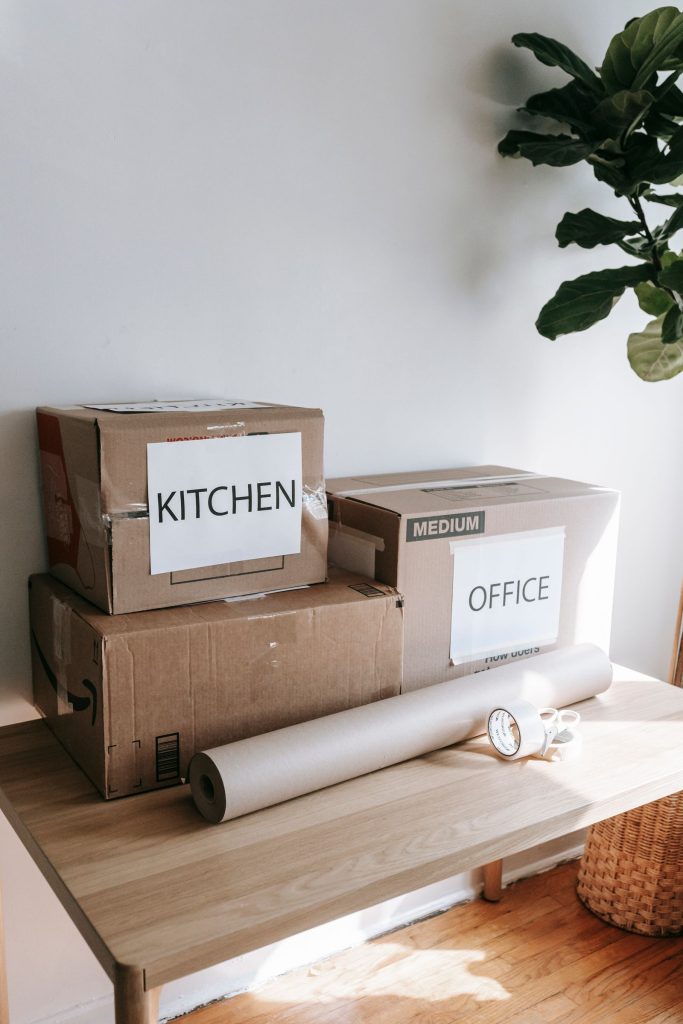
Unpacking gets asked about far less than packing and is frequently the more useful of the two, particularly for certain households.
The situation it helps most is where somebody has to function immediately. If you are back at work on the Monday after a Friday move, the difference between arriving to a house that works and one containing sixty sealed boxes is considerable, and it lasts for weeks rather than days. Boxes that are not unpacked in the first fortnight tend to stay packed for months.
It is also worth thinking about when the move is for an older relative. Packing is manageable with help. Unpacking a whole household alone, in an unfamiliar place, is genuinely hard, and it is the stage at which a downsizing move most often stalls.
What it involves is straightforward. Boxes are emptied, contents put where you want them rather than left on the nearest surface, and the packing materials taken away rather than filling a room you have just moved into. Furniture is already in position from the move itself.
It does not have to be the whole house. Kitchen and bedrooms only is a common and sensible middle ground, since those are the two areas that determine whether a house is livable on the first night.
Across Greater Manchester and the surrounding areas. Packing is usually arranged as part of a home removal or a business move, and it is priced into the same quote rather than added separately.
The move itself, with packing built into the quote.
Crates and labelling for commercial moves.
Packing that has to survive months rather than one afternoon.
Furniture taken apart and rebuilt at the far end.
It comes down to how much time you genuinely have, not how much you would like to save. Three or four weeks doing a room a week is very achievable. Three days is not, and a half-packed house on the morning is the most expensive way to move, because the crew ends up packing anyway at short notice and around people still deciding.
For most households, having us do the kitchen and the breakables and doing the rest yourselves. Those are the two areas where self-packing goes wrong most often and takes longest, and handing them over removes the bulk of the risk for a fraction of a full pack.
Yes. Materials on their own are a normal thing to ask for, and we would rather supply proper boxes than have things arrive in carriers and bin bags. Ask early enough that they arrive with time to use them.
A three-bedroom house is usually a day for a full pack. Larger houses, or ones with a full loft and cellar, can be two. Kitchen and breakables alone is normally half a day. We will tell you which yours is when we quote.
If you want us to, and it needs saying at the quote stage. Those spaces take longer per box than living rooms do, because things in them are less uniform and frequently need sorting before they can be packed at all.
Tell us and we will leave them. Most households keep a box of their own for the things needed on the first evening, and anything valuable or irreplaceable is better travelling with you than on a vehicle.
Yes, and it is worth considering for anyone who has to be back at work straight away or is moving an older relative. Boxes are emptied, contents put where you want them, and the packing materials taken away rather than left filling a room.
Yes, usually with crates rather than boxes, delivered ahead of time so staff can pack their own desks. Crates are labelled by person or desk number rather than by room, because rooms rarely survive a change of building.
Send us the details and we will quote the packing alongside the move so you can see what each option actually costs.