
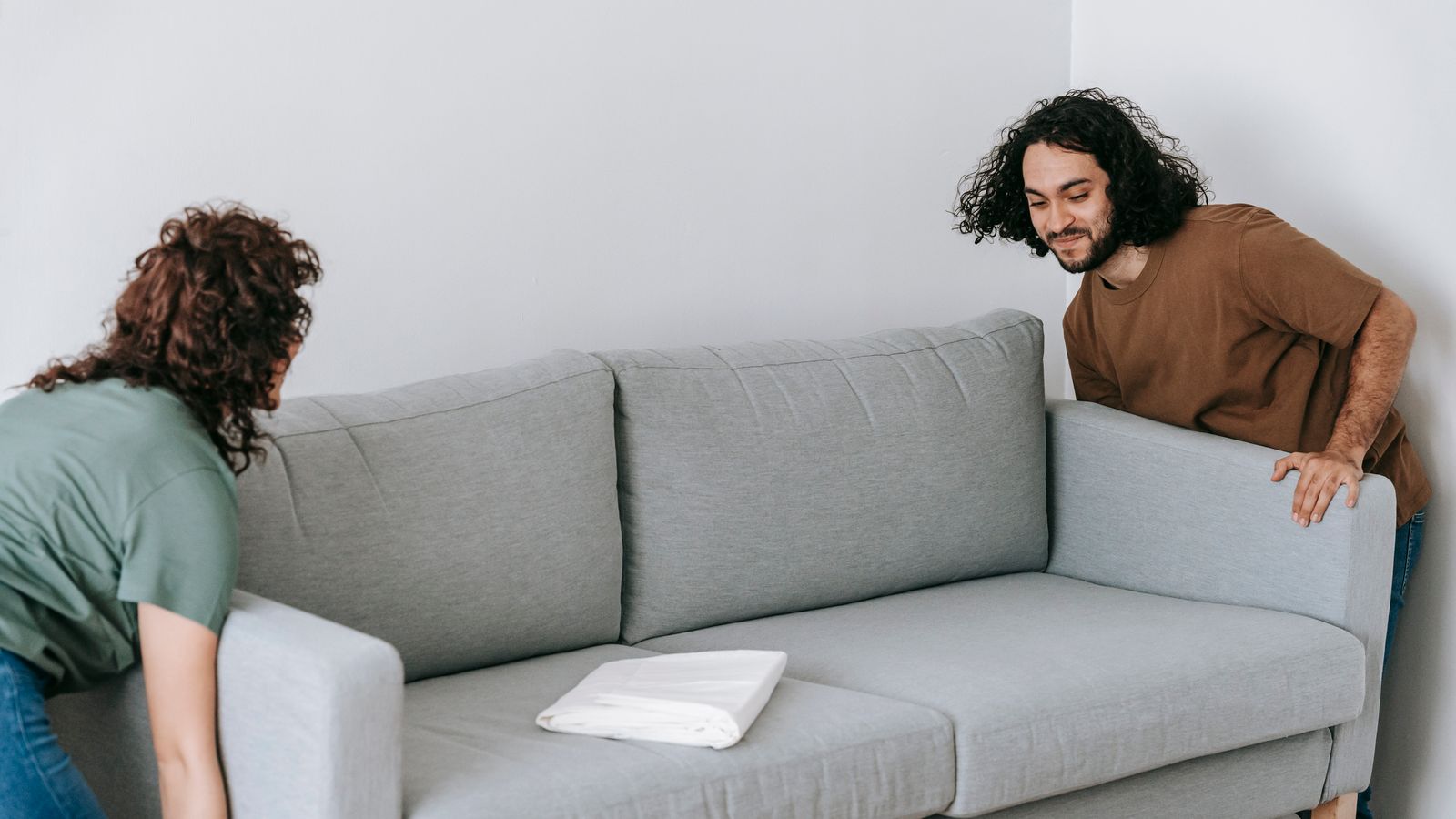
Why Sofas Jam Doorways More Than Any Other Piece of Furniture
This is a specific version of a much older problem. Mathematicians have spent decades trying to work out the largest sofa shape that can turn a right-angled corner in a corridor of fixed width, a puzzle known formally as the moving sofa problem. It remains unsolved. The practical version that turns up on Manchester moving days is smaller in scope but no less real: can this specific sofa get through this specific gap without anyone getting hurt or anything getting damaged.
Manchester’s older housing stock makes this worse than average. Victorian and Edwardian terraces in areas like Chorlton, Withington and Levenshulme often have narrow hallways, tight 90-degree turns at the bottom of the stairs, and internal doors that were never generous to begin with. A sofa that moved out of a modern new-build with 90cm doors and open-plan hallways can meet its match in a period terrace with a 76cm door and a dog-leg staircase.
Measuring Before Moving Day, Not On It
What to measure on the sofa
Take the sofa’s width arm to arm, its depth front to back, and its height including any legs or feet, which can often be removed. Then measure the diagonal across the front, from one bottom corner to the opposite top corner. This diagonal figure is the real number that decides whether a tilted sofa will clear a doorway, and it is the measurement most people skip.
What to measure in the property
Measure every doorway the sofa needs to pass through at its narrowest point, which is usually at the hinges or handle rather than the frame itself. Measure hallway width at the tightest point, not the widest. Measure stairwell width and the height of any ceiling or light fitting the sofa might catch on an upward angle. If there is a turn at the bottom or top of the stairs, measure the width available mid-turn, because this is nearly always narrower than the straight run either side of it.
Front doors are frequently the actual bottleneck rather than internal doors, particularly on terraced properties where the front door opens directly into a narrow hall. It is worth checking this specifically rather than assuming the widest door in the house will be the easiest.
The Technique That Actually Works
Step by step
Clear the cushions and any loose covers first. Check whether the legs unscrew: most modern sofas have legs that detach with a quarter turn, and removing them reduces both the height and the risk of scuffing a floor or door frame on the way through. Stand the sofa on one arm rather than its base, since this is usually the narrowest profile the piece can present.
Approach the doorway diagonally rather than head on. The leading edge should go through first at an angle, with the sofa rotating slightly as it clears the frame so the trailing edge follows the same line. This is the point where a second pair of hands earns its keep. One person should be inside the room checking clearance against the frame as it moves, and the other should be doing the lifting and steering from where they can see the path ahead.
Move slowly and stop the moment the sofa meets resistance rather than pushing through it. Resistance almost always means the angle is wrong, not that more force is needed. Adjust the angle, set the sofa down if necessary, and try again. The Health and Safety Executive’s manual handling guidance is written for workplaces but the core principles apply directly here: keep the load close to your body, move smoothly rather than jerking it, and stop rather than force a lift you are not confident about.
Equipment that helps
Furniture sliders under the sofa’s feet make it far easier to pivot on a hard floor without gouging it. Moving blankets or old duvets wrapped around the arms and corners protect both the sofa and the door frame from scuffs during a tight turn. A set of lifting straps can take pressure off two people’s backs on a staircase, distributing the weight across the shoulders rather than the arms. None of this is essential for every move, but for a sofa that is known to be a tight fit, having it ready before you start saves a lot of standing around mid-doorway working out what to try next.
When a Doorway Removal Is Worth It
Removing an internal door is straightforward on standard hinges: unscrew the hinge from the frame side rather than the door side, support the door’s weight as the last screw comes out, and set it somewhere safe until the sofa is through. This will not help with a doorway that is genuinely too narrow even without the door in place, but it accounts for a surprising number of near misses, particularly on older doors that have been rehung slightly off true over the years and sit a centimetre or two tighter than they should.
When to Stop and Call a Specialist
Sofa hoist services exist specifically for this situation and are more common, and more affordable, than most people expect. A hoist or crane lifts the sofa through an upper-floor window from outside, bypassing the internal staircase and doorways entirely. It is a genuinely routine job for companies that specialise in it, not the drastic last resort it might sound like. Costs vary by property and floor, so it is worth getting a quote before ruling it out on price alone.
Some sofas, particularly modular or corner designs, are built to be split into sections for exactly this reason. Check the manufacturer’s instructions or contact them directly before assuming a sofa is a single fixed unit. If dismantling and reassembling furniture is not something you want to take on yourself mid-move, it is a job local movers handle routinely, including for pieces that were never designed to come apart cleanly.
What It Costs If It Goes Wrong
Exactly what a landlord can and cannot deduct from a deposit depends on the tenancy agreement and the condition the property was in when you moved in, so this is worth checking in your own paperwork rather than assuming. What is consistent is that a cracked architrave or a scraped bannister is far easier and cheaper to prevent than to argue about after the fact.
If a professional team is handling the move, check what their service actually covers before the day, including how they handle a piece that turns out to be a tighter fit than expected. A reputable mover will flag a doorway problem during a survey rather than discovering it with the sofa half-wedged in a hallway.
Buying a New Sofa Around a Move
Timing also matters. Ordering a new sofa to arrive on or immediately after moving day adds one more variable to a day that already has enough of them. Building in a buffer of even a few days gives room to solve a doorway problem calmly rather than with a delivery van waiting outside.
FAQ
Most experienced movers will, since it is a routine and reversible step. It is worth asking in advance if you know a doorway is likely to be tight, so it is factored into the day rather than discovered on it.
This varies by property, floor height and access, so it is best to get a direct quote from a specialist provider rather than assume a figure. It is generally far less than the cost of repairing a damaged doorframe or replacing a sofa that was forced through and split at the seams.
Check the manufacturer’s guidance first, since not every sofa that looks modular is designed to be separated safely. Where it is, this is often the simplest solution and one local movers handle regularly as part of a standard job.
It is an unsolved mathematical puzzle about the largest shape that can be moved around a right-angled corner in a corridor of fixed width. It is a genuine, long-running problem in geometry, and while it will not help you get your actual sofa through your actual doorway, it does explain why the shape and angle matter as much as the raw dimensions.
Both, and compare them before booking a moving date. Knowing about a tight fit a week in advance gives time to arrange a door removal, a specialist lift, or a dismantling plan. Finding out on the day leaves far fewer options.
Stop pushing and pull it back the way it came rather than continuing to force it forward. Reassess the angle, remove the door if that has not already been done, and try again with someone checking clearance at the tightest point as it moves.
Cover depends entirely on the specific policy, whether it is home contents insurance, a removal company’s goods-in-transit cover, or something else, so check the policy wording directly rather than assuming. Professional movers typically carry their own liability cover for damage they cause, which is one reason to flag a known tight doorway to them in advance.