
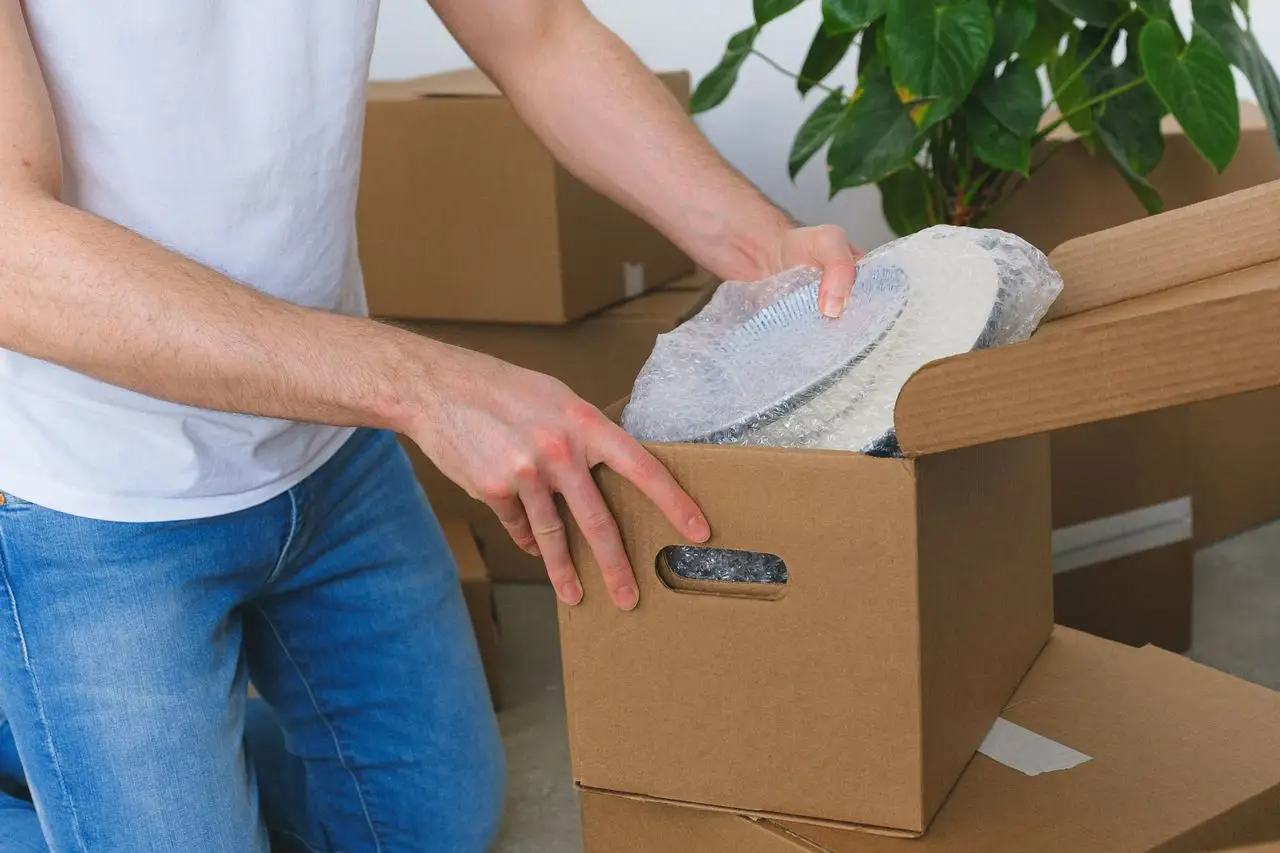
Packing fragile items for a move comes down to four things: enough cushioning (bubble wrap or packing paper, never newspaper against glazed surfaces), a sturdy double-walled box rated for the item’s weight, dividers or gaps filled so nothing shifts in transit, and clear labelling so movers know which boxes need careful handling. Wrap each piece individually, box heaviest items at the bottom, leave no empty space, and mark the box on the top and at least two sides. Do that consistently in every room and breakages become the exception rather than the rule.
That’s the short version. The rest of this guide walks through exactly how to apply it – room by room, item by item – so you’re not guessing when you’re stood in the kitchen at 9pm with a roll of bubble wrap and forty wine glasses still to go.
What You Need Before You Start
Buying the wrong materials is the single biggest reason fragile boxes arrive broken. Newspaper ink transfers onto crockery and doesn’t cushion corners properly; bin bags used as “boxes” crush under weight; and a single-wall box holding a stack of dinner plates will usually give way somewhere around the third flight of stairs.
Here’s what actually works, and what it’s for:
Material | Best used for | Notes |
|---|---|---|
Bubble wrap (small and large bubble) | Glassware, ornaments, framed art, electronics | Small bubble for wrapping, large bubble for cushioning box bases |
Packing paper (plain, uninked) | Plates, bowls, cups, filling gaps | Cheaper than bubble wrap for bulk crockery |
Dish/cell dividers | Wine glasses, stemware, mugs | Turns one box into individual compartments |
Double-walled boxes | Anything heavier than 5kg, TVs, mirrors | Single-wall cardboard flexes and splits |
Box for plates (dish-pack, small) | Plates, bowls | Small boxes stop crockery stacks getting too heavy to lift |
Picture/mirror boxes (flat, adjustable) | Mirrors, framed art, glass tabletops | Corrugated corner protectors stop cracked edges |
TV box (original or specialist) | Flat-screen TVs, monitors | Foam-lined and rigid; original box is genuinely the best option if you kept it |
Packing tape (heavy-duty) | Sealing all boxes | Use the H-taping method: seal the centre seam, then both edge seams |
Fragile tape / marker pens | Labelling | Bright colour on every side that could face up |
A rough rule of thumb: budget one roll of bubble wrap and ten sheets of packing paper per box of kitchen glassware, and you won’t run short halfway through.
If you’d rather not source and stack all this yourself, a professional packing service will bring trade-grade materials and know the dish-pack routine cold – worth weighing up against DIY time, especially if you’re also juggling a full house removal service on the same day.
Packing Fragile Items Room by Room
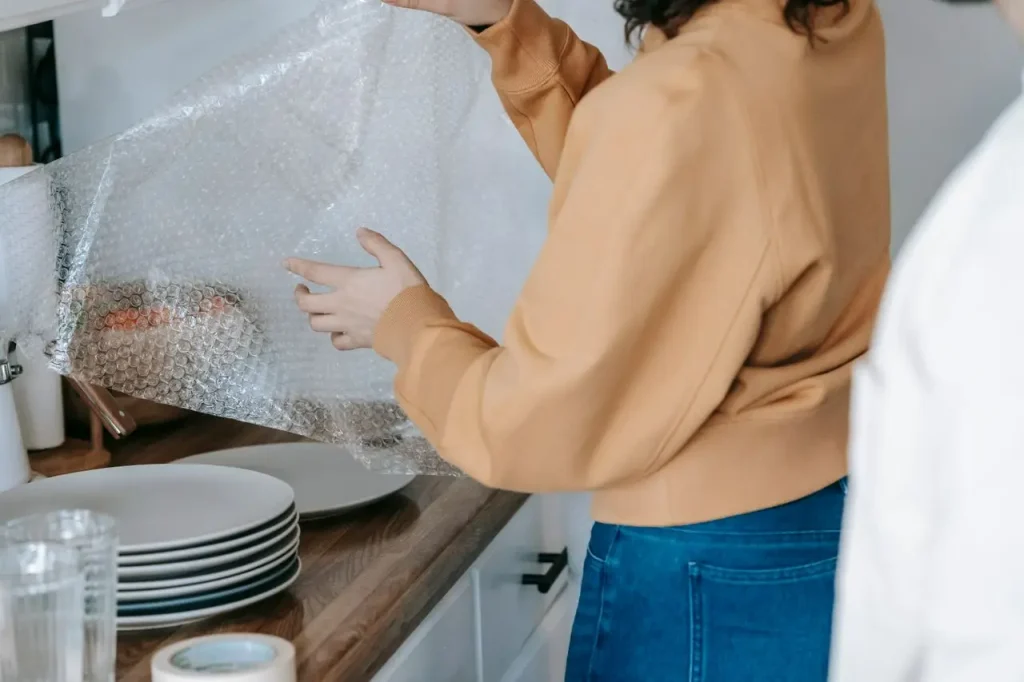
Fragile-packing technique isn’t one-size-fits-all. A wine glass and a flat-screen TV need completely different handling, and packing fragile items room by room – rather than dumping everything into generic “fragile” boxes – is what actually keeps breakage rates down. Work through the house methodically, one room at a time, and you’ll also naturally sort what needs unpacking first at the other end.
Kitchen: Glasses, Plates and Stemware
The kitchen is where most breakages happen, mainly because people rush it. Knowing how to pack glasses and dishes for moving properly takes maybe 20% longer than chucking them in a box wrapped in tea towels – but it’s the difference between unpacking a full dinner set and unpacking six plates and a lot of shards.
For plates and bowls: stand plates on their edge, never flat and stacked. Wrap each one individually in packing paper, then group three or four wrapped plates together with another layer around the group. Plates packed on edge absorb shock far better than a flat stack, which cracks under its own weight when the box gets jolted.
For glasses and mugs: wrap each glass from the base up, tucking paper or bubble wrap into the inside of the glass too – that’s the weakest point. Cell dividers are worth the few pounds they cost; they stop glass-on-glass contact completely, which is the main cause of chips.
For stemware and wine glasses: this is the most fragile category in most homes. Wrap the bowl of the glass first, then wrap again around the whole glass including the stem, and stand them upright in a dividered box, never on their side. Fill any gap at the top with scrunched paper so nothing has room to tip.
Line the base of every kitchen box with at least two inches of crumpled paper before anything goes in, and leave the same cushioning on top before you seal it.
Living Room: TVs, Mirrors, Frames and Ornaments
Living rooms tend to hold the highest-value fragile items in the house – the telly, framed prints, mirrors, glass ornaments – so it’s worth slowing down here specifically.
Knowing how to pack a TV for moving starts with the original box if you kept it; it’s moulded to the exact shape and weight distribution of your model, and nothing beats it. If you didn’t keep it, buy a specialist TV box (most box suppliers and van hire firms stock them) or wrap the screen in a thick moving blanket, then bubble wrap, then stand it upright – never flat – in a box padded on all sides. Never lay a flat-screen flat under other boxes; the panel cracks under pressure that a stack of boxes won’t even feel.
Mirrors and framed art go in flat picture boxes with corner protectors on all four corners. Tape an X of masking tape across glass surfaces before wrapping – it won’t stop a break, but it stops shattered glass scattering everywhere if the worst happens. Stand these boxes on edge in the van, never flat.
Ornaments and glass decor need individual wrapping and a snug box – too much space and they roll around; too tight and they crack under pressure from the lid. Fill every gap with paper until nothing moves when you shake the box gently.
If your living room has anything genuinely valuable – a piece of art, a collectable, an antique clock – it’s worth checking your removal firm’s transit insurance limits before moving day. The British Association of Removers notes that standard goods-in-transit cover often caps per-item value unless you declare high-value pieces in advance, so a quick call to confirm cover is time well spent.
Bedroom: Lamps and Mirrors
Bedrooms are usually treated as “easy” rooms, and mostly they are – until you get to the lamps and any wall or dressing-table mirrors.
Lamp bases wrap the same way as any ornament: individually, base first, with extra padding around the neck where it meets the shade. Lampshades should never be wrapped tightly in bubble wrap – they hold their shape better loose in paper inside their own box, since crushing a shade rarely recovers its form once you’re unpacking.
Bedroom mirrors follow the same picture-box rule as living room mirrors: flat box, corner protectors, taped glass, stood on edge rather than flat in the van.
Jewellery boxes with glass or mirrored panels, and any glass-topped bedside tables, get the same double-wrap-and-cushion treatment as kitchen glassware. If in doubt, treat anything with a glass surface as if it were a wine glass – wrap generously, don’t skimp on paper.
Home Office: Monitors and Electronics
Monitors and electronics are fragile in a different way – it’s not just about cracking glass, it’s about internal components shifting and damaging circuit boards or screens.
Pack monitors upright, screen protected first with a soft cloth or bubble wrap layer directly on the screen, then a further layer of bubble wrap around the whole unit, then boxed with padding on all sides so nothing touches the screen through the box wall. As with TVs, original boxes are best if you have them.
For anything electronic with a screen – laptops, tablets, printers with glass scanner beds – the same principle applies: cushion the screen first, then the whole unit, then fill the box so there’s zero movement. Keep cables and chargers in a separate labelled bag rather than loose in the electronics box; loose cables shift around and can scratch screens during transit.
Common Fragile-Packing Mistakes to Avoid
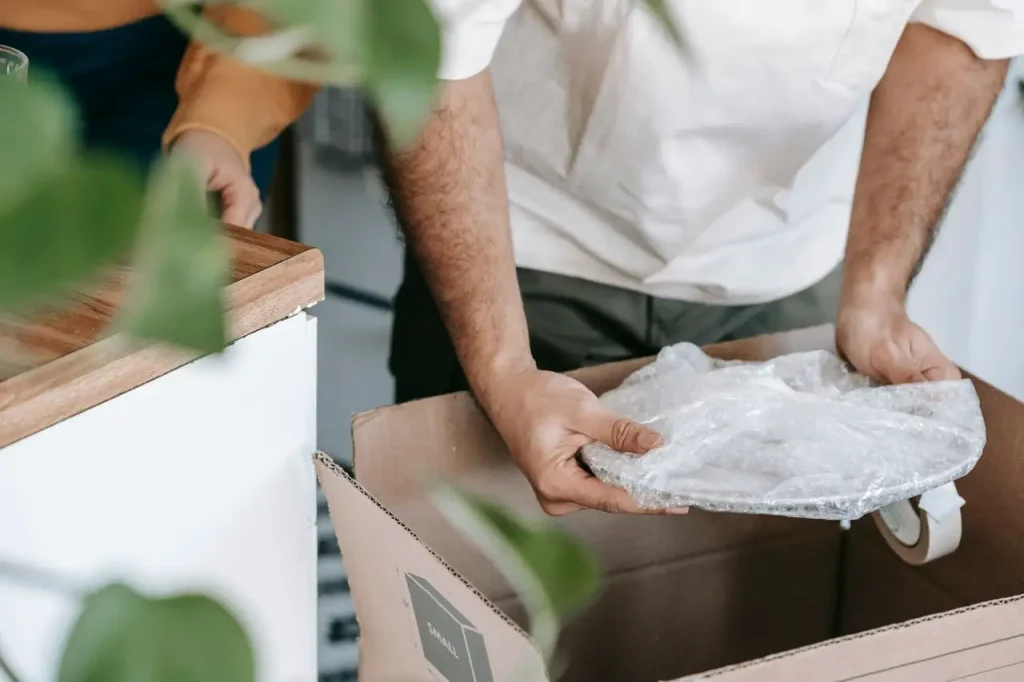
Most breakages trace back to a handful of repeated mistakes, and they’re worth knowing before you start rather than after a box arrives rattling.
Overpacking boxes is the most common one – cramming too much crockery or too many ornaments into one box makes it too heavy to carry properly, so it gets dropped, dragged, or tilted at odd angles. A packed box of glassware should weigh no more than around 15kg; if you can’t lift it comfortably with one hand free, it’s too heavy.
Underpacking is just as bad. Leaving gaps in a box means items shift and knock together every time the van brakes or turns a corner. If you can hear things move when you gently shake a sealed box, it needs more filler.
Using newspaper directly against china, glass, or anything glazed leaves ink stains that don’t come out. Plain packing paper costs a little more but doesn’t transfer ink.
Skipping the base and lid cushioning is another one people rush past – a box that’s well-wrapped inside but has nothing padding the bottom or top still lets shock through when it’s stacked or set down hard.
Not testing the seal properly matters too. Tape that only runs along the top seam, rather than in an H-pattern down the sides as well, splits under weight – and a split seam is how bottoms fall out of boxes mid-carry.
And finally, leaving fragile boxes unlabelled means the crew (or you, six hours later) treats them exactly like a box of books – stacked, tilted, shoved under something heavier. Which brings us to labelling.
A Simple Labelling and Box-Marking System
A consistent labelling system does more to prevent breakages than any amount of bubble wrap, because it controls how a box gets handled from the moment it leaves the room to the moment it’s set down in the new house.
Use this three-part system on every fragile box:
Mark the contents and room on the top of the box in large lettering – “Kitchen: Glasses” rather than just “Fragile” – so whoever’s carrying it knows roughly what’s inside and where it’s headed. A generic “Fragile” sticker gets ignored once you’ve got twenty of them stacked in a hallway; specific labelling doesn’t.
Mark “FRAGILE” and an up-arrow on at least two sides plus the top, in a colour that stands out – red or orange marker or fragile tape works better than a small printed sticker that’s easy to miss in a rush.
Number each fragile box against a simple written or phone-note inventory (Box 1 of 6 – Kitchen glassware, Box 2 of 6 – Living room ornaments, and so on), so you know immediately if one’s gone missing at the other end, which matters far more with fragile boxes than with a box of towels.
This system is worth using whether you’re doing the packing yourself or booking help – it’s exactly the kind of detail worth checking when you compare what’s included in a man and van service versus a full-service move, since some firms include fragile-item labelling and dedicated van sections as standard and others don’t.
For anyone shipping items commercially rather than moving house, Royal Mail’s own guidance on packaging fragile items follows the same core logic – cushion on all sides, clear labelling, and secure sealing – which is a useful sense check if you want a second, independent source on the technique.
If you’re still working out timings and costs before any of this happens, it’s worth doing the materials shopping alongside your wider prep – a moving checklist keeps the fragile-packing stage from becoming a last-minute scramble the night before the van arrives, and it’s much easier to estimate your move before you book once you know roughly how many fragile boxes you’re dealing with.

Frequently Asked Questions
How many boxes of bubble wrap do I need to pack fragile items for a move?
For an average 3-bed house, budget 8-10 rolls of small bubble wrap plus 2-3 rolls of large bubble wrap for TVs, mirrors and framed art. Kitchens with a lot of glassware and crockery tend to use the most, so buy slightly more than you think you’ll need – running out mid-pack is more disruptive than having a spare roll left over.
What’s the best way to pack glasses so they don’t chip in transit?
Wrap each glass individually from base to rim, tuck paper into the inside of the glass, and use a dividered box so glass never touches glass directly. Stand stemware upright rather than on its side, and fill any remaining gap in the box with scrunched paper so nothing can shift or tip during the drive.
Can I pack a flat-screen TV lying flat in the van?
No – flat-screen TVs should always travel upright, ideally in the original box, and never stacked under other items. Laying a screen flat and putting weight on top of it is one of the most common causes of cracked panels during house moves, even over short distances.
Do I need special boxes for mirrors and framed pictures?
Yes, flat adjustable picture or mirror boxes with corner protectors are worth the extra cost. A standard cardboard box doesn’t protect the corners of glass or frames properly, and corners are almost always where cracks start when a box gets knocked or dropped.
Is bubble wrap or packing paper better for plates and dishes?
Packing paper is usually better for bulk plates and bowls because it’s cheaper for the volume needed and doesn’t leave marks, while bubble wrap is worth reserving for higher-risk items like glasses, ornaments and anything with an awkward shape. Many people use both – paper as the main wrap, bubble wrap around any protruding edges.
How do I label fragile boxes so movers handle them properly?
Write the specific contents and room on the top in large letters rather than just “Fragile,” mark “FRAGILE” plus an up-arrow on at least two sides in a bright colour, and number each box against a short inventory list. Specific labelling gets noticed and acted on far more reliably than a single small sticker.
Does home or removals insurance actually cover broken fragile items?
It depends on who packed the box and what you declared beforehand – standard transit cover from removal firms typically only pays out for external damage if you packed the items yourself, and high-value pieces usually need declaring separately to be covered above a standard per-item limit. It’s worth checking the policy wording or asking your removal company directly before moving day, rather than assuming everything’s automatically covered.