
Commercial moves from MediaCity and the Quays to the industrial units at Agecroft and Irlam. We know what the managed buildings here ask for, and we get it done before the day.

In short: give us a count of desks and storage, both addresses, and whatever your building manager has said about contractor requirements. We will arrange a look round and send a fixed written price.
Commercial moves in most towns are shaped by how much there is and where the vehicle can stand. In Salford they are far more often shaped by what the building will permit, and that is a different kind of problem.
A floor at MediaCity or Exchange Quay is physically easy to move. There is a dock, a goods lift and a service corridor, all designed for exactly this. What there is also, though, is a set of requirements from building management that has to be satisfied before anybody carries anything. Method statements, insurance documents, contractor approval, lift bookings, permitted hours, sometimes names and vehicle registrations at the security desk.
None of that is difficult and all of it takes time. The businesses whose moves go smoothly here are the ones that asked their building manager for the contractor requirements in week one rather than week five. It is genuinely the single biggest predictor of whether an office move in this city runs to plan.
So the first thing we will ask you is not how many desks. It is which building, and what have they told you.
Six kinds of commercial premises, and they could hardly be more different from one another.
Modern buildings with service corridors, dedicated goods lifts and loading docks, and building management who will have written rules about all of it. Technically the easiest moves in the city and the ones needing the most paperwork beforehand.
Established office towers with shared lift cores and controlled parking. The lift booking and the security desk shape the day far more than the volume does.
Converted buildings and newer offices running towards Manchester. Narrow streets, construction traffic and loading that often has to happen kerbside within a limited window.
Older industrial and trade premises with yards and roller shutters. Level access and room to work, and jobs here are priced on racking, stock and equipment rather than desks.
Industrial estates and business units with good vehicle access and space to turn. Straightforward commercial moves in the main, with the office often the smallest part of the job.
Warehousing and distribution near the ship canal. Large volumes, easy access, and moves that are really about stock and racking with an office attached.
Six questions. Ask them as soon as you have a target date, and send us the answers. Every one of them is straightforward weeks ahead and capable of stopping a move on the day.

A count of desks and storage, both addresses, and the window you can work in. Nothing is booked until you say yes.
Every commercial move has a handful of things that must not go on a vehicle, and a handful more that should not be packed at all until the last moment. Sorting them out beforehand takes an hour and prevents the problems that are hardest to fix afterwards.
The things that travel with a named person rather than in a crate are consistent. Laptops, phones and tablets. Keys, fobs and access cards, including the set going back to the old landlord. Anything holding client or personal data. Petty cash, cards and cheque books. And the small expensive items that are easy to lose and awkward to replace, which in most offices means adaptors, dongles and the one cable that nothing else works without.
The things that should be packed last and unpacked first are different. Whatever the business needs to answer a phone and send an email. The current paperwork rather than the archive. Chargers, and enough of them. Somebody should own that box and it should travel in a car.
Then there is the category people forget entirely, which is anything with a liquid in it. Cleaning products under the sink, the water cooler bottle, milk in the fridge, and in workshops anything in a drum or a tin. Drain what can be drained the day before and deal with the rest properly rather than discovering it has leaked across a crate of paperwork.
The difference between an office that works on Monday and one that does not is almost always labelling, and almost every business gets it wrong in the same way.
The instinct is to label by room. Everything from the second floor goes to the second floor. It feels logical and it fails immediately, because new premises are never laid out like old ones. The second floor might be one floor, or three separate areas, or somewhere that does not exist in the new building at all.
Label by person and by function instead. This box belongs to a named individual, that cabinet belongs to a named team. People survive a change of building. Room numbers do not. When a crate arrives labelled with somebody name, anybody can put it in the right place without asking, and that person can start working the moment they find their desk.
Two practical additions. Number the desks in the new plan and give everybody their number before the move, so their crates are labelled with a destination that physically exists. And label the first-day items differently from everything else, with a colour or a large mark, so the things needed immediately do not end up at the back of a stack of identical boxes.
It takes an afternoon to set up and it removes most of the chaos from the first morning.
The contents of the premises, including the parts that are easy to forget when you are picturing desks.
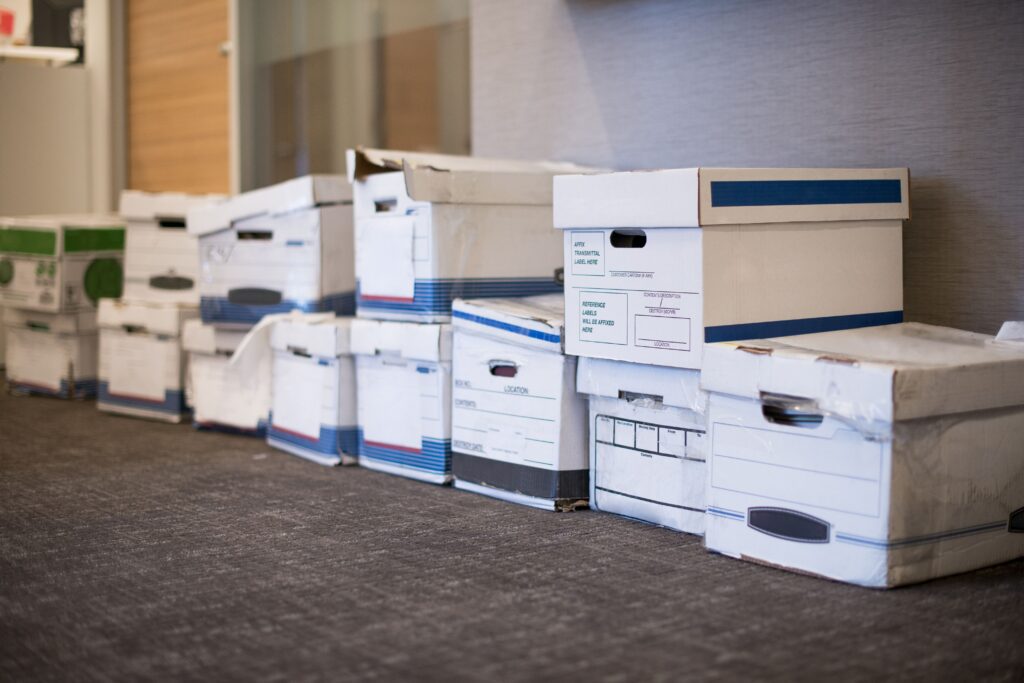
A good share of the office moves we now do in Salford are not businesses relocating so much as businesses resizing. Hybrid working has left a lot of organisations with more desks than people, and others have grown and need room they cannot get in their current building.
Moving to less space is the harder of the two, because it is not really a removals question at all. It is a series of decisions about what survives, and those decisions are much easier made against a floor plan than against a memory. Get the new layout, count the desks and storage it will actually hold, and compare that with what you have. The gap is what has to go, and knowing the number early gives you time to sell, donate or store it rather than deal with it in the final week.
Moving to more space brings the opposite problem, which is the temptation to bring everything on the basis that there is room now. Furniture that was tired in the old office does not improve by being moved, and paying to transport it is money spent on something you will replace within a year.
In both directions the useful question is the same. If this arrived at the new premises in a delivery van tomorrow, would you accept it or send it back? Anything you would send back should not be on the vehicle.
Five things, and in this city the second one carries unusual weight.
Desks, storage units and racking bays. Those three numbers size a commercial move almost exactly. Staff headcount and floor area do not, because businesses differ enormously in how much they keep.
Permitted hours, lift booking, dock access and contractor approval. In managed buildings this shapes the price as much as the volume, because it dictates when the work can happen at all.
Phased moves cost more in total and less in disruption. Which is cheaper depends entirely on what an hour of your business not working is worth.
Anything hard wired, plumbed in, or under a warranty that requires an approved engineer. The cost is in the coordination rather than the lifting.
Staff clearing their own desks into crates the afternoon before genuinely reduces the bill, provided somebody owns it and the crates arrive in time.
Across the Salford postcodes, including MediaCity and the Quays, Exchange Quay, Chapel Street, Ordsall, Eccles, Patricroft, Barton, Agecroft, Swinton, Worsley, Walkden, Irlam and Cadishead. Our business removals page covers the wider Greater Manchester area.
Commercial moves across Greater Manchester, from one office to a whole premises.
Our main Salford page, covering domestic moves across the city.
For a fit-out that overruns, or furniture the new space cannot take.
Desks, benching and storage taken apart and rebuilt.
It is driven by the count of desks and storage, what the two buildings permit, and the hours we can work. A unit in Agecroft on a weekday and a floor at the Quays restricted to evenings are very different figures for the same furniture. Give us the numbers and both addresses and we will arrange a look round first.
Usually more than people expect. Many buildings require a method statement, evidence of insurance and contractor approval before we are allowed on site, plus lift booking and sometimes protective panels in the lift car. Ask your building manager for their contractor requirements early and send them to us. It is routine, it just takes time.
Yes, and in a lot of Salford buildings it is not optional. Managed buildings frequently restrict moves to evenings or weekends, which suits most businesses anyway. It needs authorising by the building rather than by you, so start that conversation early.
We move it physically, including packing and reinstalling where it is a matter of putting things back. Anything requiring a specialist engineer or recommissioning under warranty needs that person booked, and we build the schedule around them.
Four to six weeks is comfortable for a straightforward office. In managed buildings the approvals typically set the timetable rather than our diary, and those can take several weeks on their own.
Yes, and with office moves it is worth asking about at the start rather than the end. Fit-outs overrun often. Equipment goes into storage and comes out in the order you want it rather than everything arriving at once.
Yes, and it is an increasingly common conversation. Tell us the new floor plan and we will be honest about what will and will not fit. Surplus furniture can go to storage, to resale or to a reuse organisation, and deciding that early costs far less than deciding it on the day.
Yes, and the rest of the Salford postcodes, including Chapel Street, Ordsall, Agecroft, Barton, Worsley, Walkden and Cadishead.
Send both addresses, a count of desks and storage, and what your building requires. We will arrange a look round and come back with a fixed written price.