
One of the larger industrial estates in Stockport, sitting beside a motorway junction. Easy to reach, which is exactly why the roads around it are never quiet.

The short version. Tell us what the unit holds, how a vehicle gets alongside and what has to keep running. We will survey it, then price it in writing.
Bredbury exists commercially because of where it sits. A motorway junction on the doorstep is the reason the estate is here and the reason so much distribution and light industrial chose it, and for a removals firm that is genuinely helpful. Getting a large vehicle to a unit here is easier than almost anywhere else in the borough.
The other side of that is traffic. The roads carrying motorway traffic onto and off the estate are busy through the working day rather than in neat peaks, which means a mid-morning start is no faster than an early one and a move involving several trips loses time on every leg.
The premises themselves divide into two. The newer units on Bredbury Park Way have their own yards, shutters and level access and are about as straightforward as commercial property gets. The older parts of the estate have a wider range of sizes, more subdivision and more shared access, which changes how a move has to be arranged rather than how hard it is.
Knowing which you are in is where we start, because the second one needs conversations with neighbours that the first one does not.
Six kinds of premises within a fairly compact area.
Modern units on the main estate, with yards, shutters and level access designed in. Physically the most straightforward commercial work in the area and usually the largest by volume.
Older established units alongside the newer ones, with a wider range of sizes and a good many buildings holding more than one business.
Trade counters and light industrial along the corridor, with reasonable access and kerbside loading where yards are shared.
Small offices, clinics and premises above retail along the older centre. Stairs rather than lifts, and controlled parking through the middle.
Smaller units and professional premises serving the residential areas. Straightforward in the main, with street parking as the usual limitation.
Premises on the lower ground towards the river, where the approach drops away and the gradient decides the vehicle rather than the route.
Four things, and the first is the one businesses here tend to take for granted.

The estate sits beside a motorway junction and the approach roads carry that traffic all day. Which direction a vehicle comes from, and at what hour, affects the day more than the distance does.
Whichever you actually have. Bredbury holds distribution, light industrial and small offices, and each is counted differently.
The newer units have their own. The older ones frequently share, which means arranging the move with neighbours rather than around them.
Fully operational, partly running, or simply moved. All three are legitimate and they produce different plans and different figures.
Bays, benches or desks, both addresses, and the window you can work in.
Businesses on this estate hold a surprising amount of equipment that is neither furniture nor stock, and it is the category most often left off a list until somebody walks the unit properly.
Compressors, extraction, dust and fume systems, three phase equipment, air lines running along a wall, and anything fixed to a mezzanine. Some of it belongs to the business and some was installed by a previous occupier and simply inherited. Establishing which is which is worth doing early, because the answer is frequently less obvious than it looks and it determines what is actually coming.
Anything requiring a qualified person to disconnect needs booking for the day before rather than the morning of. This is the single most common cause of a commercial move overrunning and it has nothing to do with removals. A crew standing beside a machine still connected is time that cannot be recovered.
The floor at the new unit matters too. Anything heavy needs to be going somewhere that will take it, and anything requiring bolting down needs the fixings resolved before it arrives rather than after. Moving a machine twice inside the same building because nobody confirmed the position is more common than it should be.
Finally, ask the landlord what has to stay. Fixtures installed during a tenancy are sometimes the landlord property by the time the lease ends, and taking something that should have remained creates a dilapidations argument months later. That conversation is straightforward at the start and awkward at the end.
This is the local knowledge worth having, and it runs contrary to what most businesses assume about being near a junction.
The advantage is real. A lorry can reach the estate from anywhere in the region quickly, there is no city centre to negotiate, and turning and loading space is generally good. For a business moving in or out of the region, that saves genuine time at the start and end of a run.
The cost is that the roads immediately around the junction carry that traffic constantly. It is not commuter traffic that clears by ten, it is a steady flow of vehicles using the estate and the junction throughout the day. A move that involves several trips between premises, or between a unit and a storage facility, pays that toll on every leg rather than once.
What follows is that out-of-hours work is worth more here than in most places. An evening or a Sunday is not simply quieter for your staff, it is measurably faster on the road, and on a multi-trip job that difference compounds into hours rather than minutes.
The second consideration applies to any business taking or sending goods. Your own deliveries keep to their own schedule regardless of what you have planned, so the move needs to sit in a gap rather than across one. Work out what is due in and out during the move week and either pause it or arrange for it to land at the new address.
Third, if you are moving to a unit elsewhere on the same estate, which happens frequently as businesses grow or contract, the short distance is deceptive. A move of four hundred metres still involves loading, travelling, and unloading through the same shared access as everybody else, and it benefits from the same planning a longer one would get.
Whatever the premises holds, from pallet racking to reception furniture.
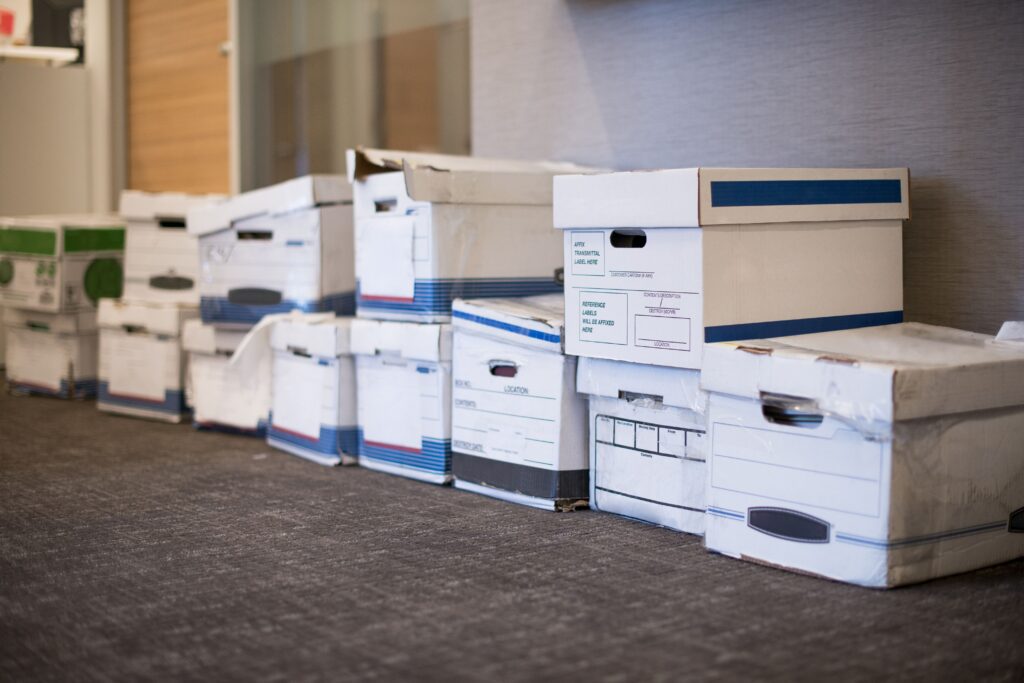
A good share of the commercial moves we do in Bredbury are businesses relocating from one unit to another a few hundred metres away, and those jobs have a trap in them worth naming.
Because the distance is trivial, they get planned casually. The vehicle can go back and forth all day, so decisions get left open, and anything undecided is put on the next trip. The next trip becomes the one after that, and a move that should have finished at four is still going at seven with everybody tired and nobody making sensible choices about where things belong.
The way round it is to plan as though the vehicle is leaving and not returning. Agree what goes and where it lands before anything is lifted, load to that plan, and treat additional trips as capacity rather than as a substitute for deciding.
Short moves do have a real advantage though, and it is worth using properly. Where both units are available at the same time, even for a few days, the job can be split. Archive, slow-moving stock, spare equipment and seasonal materials go across first during normal working hours at no disruption to anybody. What remains on the main day is only what the business is actively using, which is a much smaller and far less risky job.
That approach usually costs less than a single large out-of-hours move and it removes most of the risk, because by the time the critical day arrives the majority of the volume has already gone. For a business growing into a second unit rather than replacing one, it is almost always the right structure.
Five things, and for anything holding stock the third is the one most often underestimated.
Counted with every door open, including the mezzanine, the stores and whatever has gathered at the back over the years.
Most of the estate is flat and easy. Premises on the valley side towards the river are not, and a loaded vehicle needs a considered position rather than the nearest space.
Anything metal, tinned or liquid is far heavier than the space it occupies. On a distribution job this frequently leads the whole quote.
Evenings, weekends or a shutdown period. Fixing it early keeps more crews available and costs less than deciding late.
Hard wired equipment, plumbed-in machinery, anything under a service agreement. The cost is in coordinating them, and their diary usually sets the date.
Bredbury and the surrounding area, taking in Bredbury Park Way, the older estate, Horsfield Way, Woodley and Romiley. The wider borough is covered on our Stockport office removals page, and work further afield on our business removals page.
Commercial work across the wider region.
The wider borough, including the Exchange and the Reddish mills.
Space for stock while a unit is being fitted out.
Benching, racking and workstations taken down and rebuilt.
Both, and it is worth understanding which. Getting a vehicle to the estate is easy, which is why so much distribution sits here. The approach roads carrying that traffic are busy through the working day rather than at peaks, so the timing of a move matters even though the access itself is good.
On bays, pallet spaces and racking runs, plus what the stock actually is. Floor area tells us little, because two units of the same size can hold completely different amounts depending on how they are racked and what is in them.
It can. The approach drops away on that side and a loaded vehicle needs somewhere sensible to stand rather than the closest gap. It is worth mentioning at the survey so the right vehicle is allocated.
Tell them, and tell whoever manages the estate. It takes two phone calls and it prevents the situation where a delivery and a removal need the same access at the same moment.
Yes, and the order matters more than the lifting. Racking down, floor clear at the new unit, racking up, then stock. On a unit of any size that means the racking travels ahead of the stock rather than with it.
Yes. Evenings, weekends and shutdown periods are normal for commercial work. Where the estate or a landlord restricts access hours, that needs authorising in advance rather than assumed.
Six weeks is comfortable for anything with racking or stock. The constraint is rarely our diary. It is connectivity at the new unit, any engineer needed and landlord sign-off.
Bredbury, Bredbury Park Way, Horsfield Way, Woodley, Romiley and the roads towards Stockport and the Tame valley.
Send what you have and when it needs doing. We will look at both units and come back with a written figure.