
Office Removals in Leigh
Workshops at Bickershaw, trade counters at Parsonage and small practices above the shops in town. Most commercial premises here are not offices, and we price them accordingly.
- Workshops and trade units
- Shift patterns worked around
- We look before we price

Count the right things
The short version. Tell us what the premises actually holds, where it is going and what has to keep running. We will look at it, then price it in writing.
The commercial stock around Leigh is mostly industrial and trade rather than office, and that changes the first question we ask. A business here is far more likely to be counting benches, bays and pallets than desks and cabinets.
It matters because the two are priced on different things. An office move is driven by volume and downtime. A workshop or trade unit is driven by weight, by racking, and by whether orders are going out that week. Quote a workshop as though it were an office and the figure will be wrong in both directions at once.
So we would rather have four honest numbers than a description. How many benches or bays. What is heaviest. Whether we can drive alongside. And what has to be working again first.
Where businesses are around Leigh
Six kinds of premises, and the gap between the easiest and the hardest is mostly about whether a vehicle can get alongside.
Bickershaw and the industrial estates
Workshops, light manufacturing and storage on the southern edge of the town. Yards, shutters and space to turn, and the office is usually a small part of a job that is mostly equipment and materials.
Parsonage and the retail parks
Retail units and trade counters with service yards and delivery bays. Loading is designed for, but the bays are shared and the trading hours set the window rather than the volume.
Leigh town centre
Professional offices above shops, small practices and independent retail. Older buildings, stairs rather than lifts, and street loading with parking restrictions to work around.
Stone Cross and the Lowton corridor
Modern business park units close to the East Lancashire Road, with proper parking and level access. Physically the most straightforward commercial moves in the area.
Astley and Tyldesley
Smaller units and workshops serving the eastern side. Mixed premises, frequently office and workshop in the same building, and usually easy vehicle access.
Atherton
Trade premises and small offices along the main routes. Straightforward in the main, with kerbside loading as the usual constraint.
What we need to know
Four things, and none of them takes long to establish. Everything else we can work out on site.

Whichever of the three you actually have. Most premises around Leigh are workshop or trade rather than pure office, and counting the wrong thing produces the wrong price.
Materials, stock, tooling and anything metal or liquid. A half-empty unit can be a bigger job than a full office, and only you know which yours is.
A shutter and a yard, or a flight above a shop. That single difference outweighs almost everything else on this list.
Some businesses can shut for two days. Others have orders going out on the Monday regardless. Both are workable and they are planned very differently.
Give us the numbers
Benches, bays or desks, the two addresses, and when it needs to happen. Enough to get started properly.
Running a move round a working week
Most of the businesses we move around Leigh are small, and the person organising the move is generally also the person running the company. That rules out anything resembling a formal project plan, so what follows is the version that fits round a working week.
Start the things with lead times first, because those are the only ones that cannot be recovered later. Connectivity at the new premises. Any engineer needed for disconnection. Anything the landlord has to sign off. Every one of those runs to somebody else timetable and none of them can be compressed once you are inside it.
Then walk the unit with every door open and decide what is not coming. This is the cheapest saving available on any commercial move and it is the one most often skipped, because it takes an hour and produces no visible progress. Moving materials you will scrap within six months costs money twice.
Give one person the whole thing, even if that person is you, and tell everybody who it is. Moves come apart when three people each assume somebody else booked the phones. Write the date and the four or five things that have to be true by then, and keep the list somewhere other people can see it.
Then hand the physical work over. Whether the benches arrive undamaged is our problem to solve. Whether your customers can still find you in a month is yours, and it is the part worth your attention.
Moving a business that runs shifts
A good number of the businesses around here do not work a standard week, and that is an advantage on a move rather than a complication. It just needs using properly.
Most nine-to-five businesses have exactly one option, which is a weekend, and everybody wants the same ones. A business running shifts almost always has a genuine gap somewhere else. A quiet Tuesday night between runs. A Sunday day shift that is lighter than the rest. A changeover period where the floor is emptier anyway. Those windows are easier to book, cheaper, and usually longer than a Saturday.
The thing to be careful about is the handover between shifts. A move that starts during one shift and finishes during another needs somebody who is across the whole thing rather than two people who each know half. Name one person and have them there for the join, even if that means an awkward hour in the middle.
It is also worth deciding what the incoming shift needs to find working. Rarely everything. Usually one line, one bench area or one part of the floor. Setting that up first and letting the rest follow means production restarts hours earlier than it otherwise would.
Tell us the shift pattern at the quote stage rather than after the date is set. It is one of the few pieces of information that can genuinely make a commercial move cheaper.
What we move
Whatever is in the premises, whether that is desks or drill presses.
- Benches, tooling, racking and materials
- Desks, chairs, screens and storage units
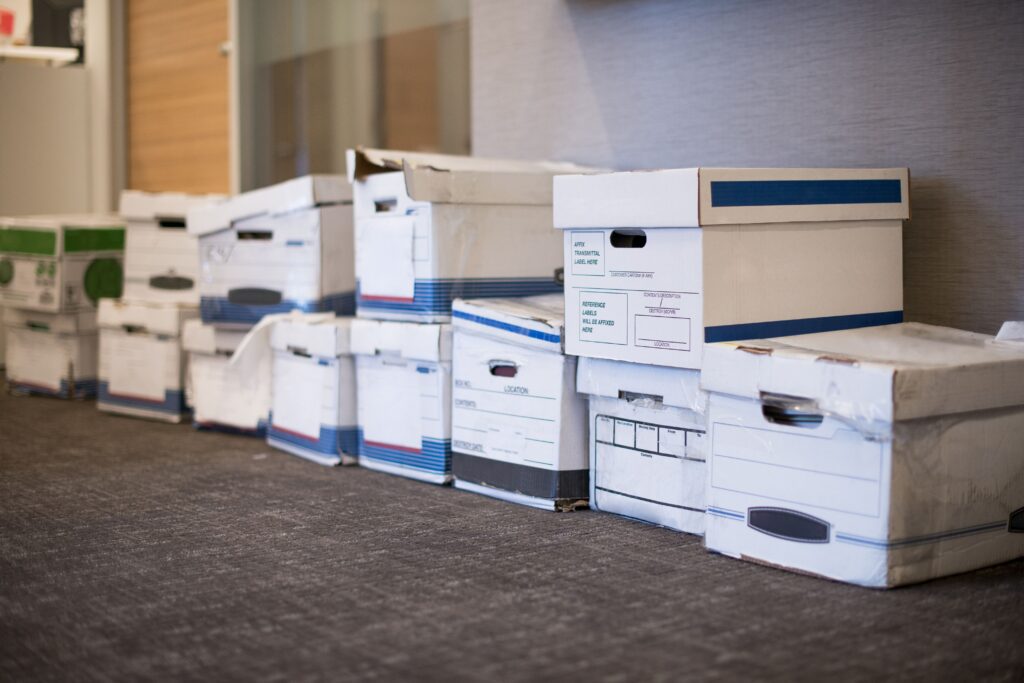
- Filing cabinets, archive boxes and records
- Server cabinets, comms equipment and network kit
- Trade counter fittings, displays and stock
- Kitchen and staff room equipment
- Safes and heavy items, given enough notice
- Storage while a unit is fitted out
The two weeks afterwards
The fortnight after a commercial move gets almost no planning and is where most of the actual disruption sits. It is worth setting expectations for it rather than being surprised.
The first few days will be slower than normal. Nobody knows where anything is, half the questions in the building are about the building, and jobs that took five minutes in the old unit take fifteen. Booking anything demanding into that window is optimistic, and so is promising customers you will be at full speed immediately.
Resist unpacking everything at once. Anything that does not need opening should stay boxed, because opening every crate immediately is how a new unit fills up with things nobody actually wanted to bring. After two weeks a surprising proportion can go straight out unopened.
Put one person in charge of the question where is it, and make sure the whole team knows who that is. Not a spreadsheet, a person. It costs nothing and it stops the same question being asked thirty times in the first week.
Then deal with the old premises properly. Walk it once it is empty, photograph every area, and read the meters. If you are handing a unit back to a landlord, the condition it is left in usually matters to a deposit or a dilapidations claim, and photographs taken on the day carry far more weight than a recollection two months later.
Machinery, tooling and the order of work
On any move involving machinery, the removals are the straightforward part. What decides whether the week goes well is the sequence, and it is almost always the sequence that goes wrong rather than the lifting.
The rule that matters is that disconnection happens before we arrive, not alongside us. An engineer booked for the same morning as the move produces a crew standing next to a machine still bolted to a floor, and there is no way to recover the hours that costs. Booked for the afternoon before, everything flows.
The second thing is that machines frequently need more than a van. Weight, awkward centres of gravity and the need to keep something level all mean the right equipment rather than more people. Tell us what the heaviest item is and roughly what it weighs, even approximately, because that single number determines what we bring.
Third, think about the floor at the new unit. Anything heavy needs to be going somewhere that will take it, and anything requiring bolting down needs the fixings sorted before it arrives rather than after. It is common for a machine to be moved twice inside the same building because nobody confirmed where it was going.
Finally, tooling and small parts. These are worth more than they look, they are easy to lose, and they should be crated and labelled by machine rather than swept into a general box. A machine that arrives without its tooling is a machine that is not working.
What the cost turns on
Five things, and for most premises around Leigh the third one carries more weight than people expect.
What is actually in the unit
Counted rather than guessed, including the mezzanine, the stores and the corner where materials have been accumulating since before anybody current started.
Getting a vehicle alongside
Yard and shutter, shared service bay, or a public street. In this area that is the widest single variable in a commercial quote.
Weight rather than volume
For workshop and trade premises this frequently dominates. Anything tinned, metal or liquid is far denser than the space it occupies suggests.
The hours you need
Evenings, weekends or a shutdown period. Fixing it early keeps more crews available and costs less than deciding late.
Specialist disconnection
Machinery, catering equipment, anything hard wired. The expense is in coordinating it, not in the lifting, and their diary usually sets the date.
Where we work
Leigh and the surrounding area, taking in Bickershaw, Westleigh, Pennington, Parsonage, the town centre, Astley, Tyldesley, Atherton, Lowton, Golborne and the business units along the Stone Cross corridor. Work further afield is on our business removals page.
You might also need
Business removals
Commercial work across the wider region, beyond this corner of the borough.
Removals in Leigh
Household moves across the same streets.
Storage
Space for stock and equipment while a unit is being prepared.
Dismantling and reassembly
Benching, workstations and storage taken down and rebuilt.
Common questions
Can you price it without visiting?
For a small office, often. For a workshop or a unit with stock, no, and any figure we gave you would be wrong. Twenty minutes on site with the doors open is what turns an estimate into a price that holds.
We work shifts. Does that help or hinder?
It usually helps, because there is nearly always a genuine gap somewhere in the week that a nine-to-five business does not have. Tell us the pattern and we will find it rather than defaulting to a weekend.
Who moves the machinery?
We move it once it is disconnected. The disconnection itself needs whoever is qualified for that particular machine, and the sequence matters more than most people expect. Booked the day before, everything runs. Booked the same morning, the day stops.
Is racking your job?
Yes if you want it to be. The important thing is that it goes up before the stock arrives rather than alongside it, which on any unit of size means a separate day for the racking.
How much notice is sensible?
Six weeks is comfortable. The constraint is rarely our diary. It is connectivity at the new unit, engineers and any landlord sign-off, all of which have lead times that cannot be shortened once you are in them.
Can you store equipment for us?
Yes, and it comes up often when a unit is being fitted out. Things go into store and come back in whatever order suits you rather than all at once.
What about the stock we are not keeping?
Tell us at the quote stage and where you would like it to go. Some has resale value, some can be donated within limits, and some can sit in storage while a decision is made.
Which areas do you cover?
Leigh and everything around it, including Bickershaw, Westleigh, Pennington, Astley, Tyldesley, Atherton, Lowton, Golborne and the units along the Stone Cross corridor.
Book it in
Send what you have and when you need it done. We will arrange to see the premises and follow up with a written figure.