
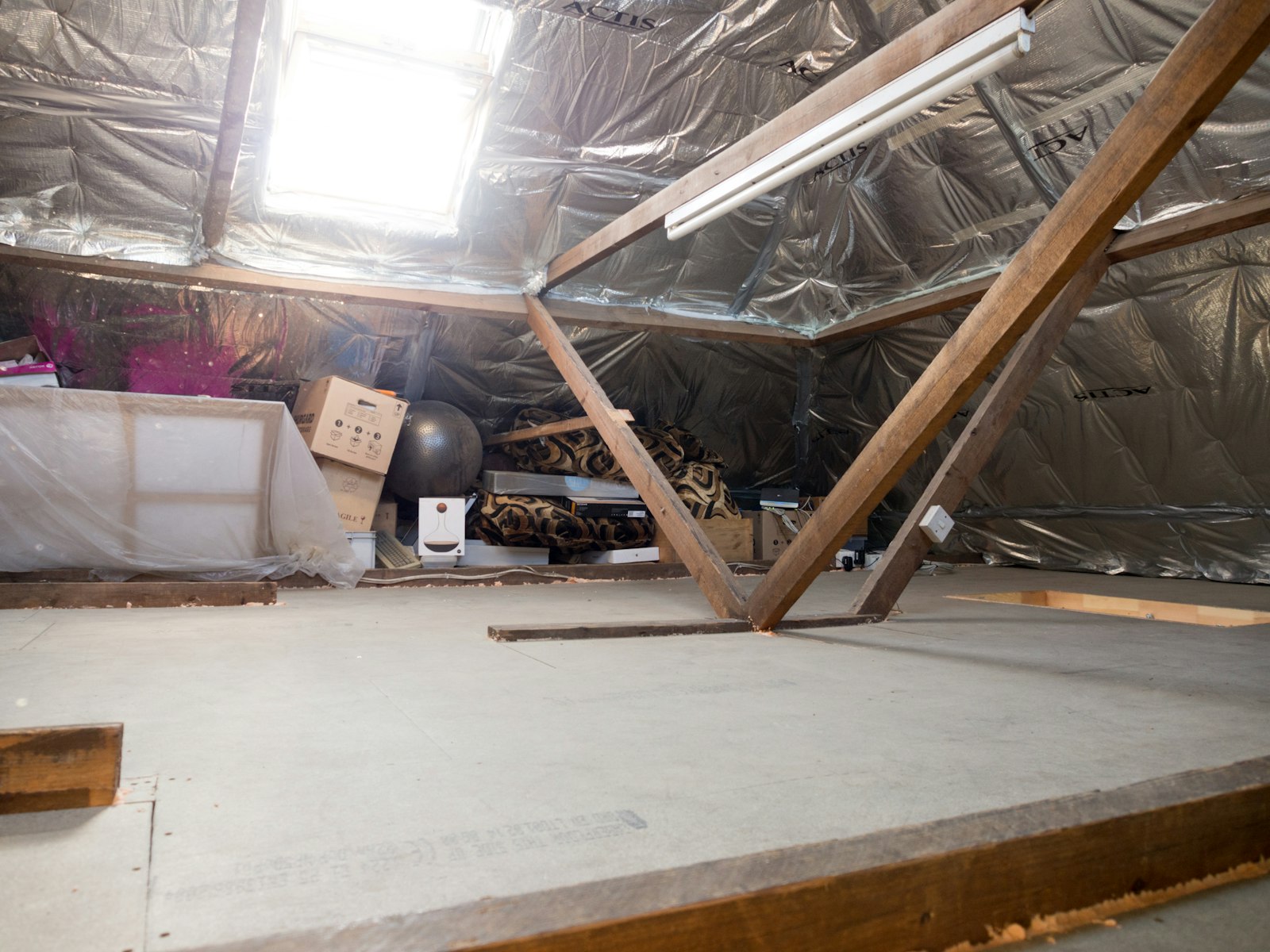
Quick answer: a loft is not really storage, it is a place to put decisions you would rather not make, and a move forces every one of them at once. Do it in daylight rather than evenings, use two piles instead of four, and judge each item on whether it is worth moving rather than whether it is worth keeping. Check your recycling centre’s booking and van permit rules before loading anything, because that is where the wasted Saturdays happen.
Somewhere around the third hour, a pattern emerges.
It starts well. Two people, a Saturday morning, a ladder and a reasonable amount of optimism. The first few items are easy because they are obviously rubbish: a broken parasol base, a bag of packaging from a television bought in 2015, a box of tiles left over from a bathroom that has since been replaced. Down they go, into a pile by the front door, and the whole thing feels manageable.
Then somebody finds the bread maker.
It was used twice. It cost a reasonable amount. It works perfectly well and would, in theory, be used again if circumstances were different. It has been in the loft for nine years and will be in a loft for another nine unless somebody makes a decision about it in the next ninety seconds, standing on a joist, holding it at arm’s length, while the person below asks what the hold-up is.
This is the actual difficulty with lofts. Not the lifting. The bread maker.
Why Lofts Fill Up in the First Place
Genuinely useful things live in cupboards you can reach. Genuinely useless things go in the bin the week they break. What ends up in the loft is the middle category: still works but not needed, might be worth something, belonged to someone, too good to throw away. Every one of those is a decision deferred, and the ladder is the price of deferring it.
Look at what accumulates up there and it is almost never things with a clear status. That is why the pile grows: the cost of postponement is low, and it is paid in one instalment, years later, by whoever is moving house.
The consequence at moving time is that you are not doing a clearance job. You are working through a decade of postponed judgement calls in a confined space with insufficient light, usually while somebody waits at the bottom of the ladder. It is no wonder people leave it until last.
There is a reasonable argument that this is fine, and that a loft full of unmade decisions harms nobody. That argument collapses the moment you move house, because now every single item has to be picked up, carried down, and put somewhere. The decision arrives whether you want it or not. The only question is whether it arrives eight weeks out or on the Thursday before completion.
Start on a Saturday Morning, Not a Wednesday Evening
Loft work in the dark is worse in every measurable way. The light is poor, you are already tired, and nowhere is open to take anything, so everything you bring down simply relocates to the landing. A Saturday morning with somewhere to take things beats four weeknight evenings with nowhere to put them.
By eleven o’clock on a weeknight the sorting has stopped and you are moving objects from one floor to another, which is the least useful thing it is possible to do during a house move.
Get three things ready before anyone climbs up.
A work light that stands on its own, because a phone torch means one hand for the torch and one hand for everything else. Boards to kneel on if the loft is not floored, because insulation hides where the joists are and plasterboard will not hold you. And a ladder that is fixed or properly footed, since a stepladder balanced at the top of a stairwell is genuinely how people get hurt.
Wear old clothes and something over your mouth if the insulation is old and dusty. Lofts are filthy in a way that surprises people every time.
The Four Piles, and Why Three of Them Are a Trap
Most households instinctively create four piles: keep, sell, donate, tip. Three of them cause problems, because they let items sit undecided while feeling productive. Two destinations with a hard rule works better, and the pile that behaves itself is the one people are most reluctant to fill.
Sell becomes a holding pen. Everything ends up in it, because “I’ll sell that” feels responsible in a way that “bin it” does not. The pile grows, nothing gets listed, and eight weeks later it goes to the tip anyway, having occupied the garage in the meantime. Selling is worth doing for a narrow band of things: tools, furniture in decent condition, anything with an actual collector’s market, and equipment that was costly when new and still works properly. Four or five items, not forty.
Donate feels good and is frequently wrong about what charities can accept. Shops cannot sell electrical goods without testing them, cannot take upholstered furniture without the fire safety label attached, and have very little storage. A car load arriving unannounced is often refused, not out of unkindness but because there is nowhere to put it.
Keep expands to fit whatever space you imagine having in the new house, which is always more than the space you will actually have.
A better approach is a hard rule and no middle ground. Not used in two years and not sentimental: it goes. Anything that takes more than about ten seconds to decide: it goes, because the hesitation is the answer. Put the piles in physically separate places, ideally different rooms or different parts of the drive, so nothing quietly migrates from tip back to keep at four in the afternoon when everyone is tired.

So What About the Bread Maker?
It goes. Nine years of not using something is not a temporary state of affairs, it is a settled preference. The useful reframe is to stop asking whether an item is worth keeping and start asking whether it is worth moving, because everything up there is going in a van, at a cost, to be carried up another set of stairs.
Not because bread makers are bad. The version of you who was going to bake bread was real and sincere, and has now been outvoted by a decade of buying it instead.
The reason this is hard has a name. People weigh what something cost rather than what it is now worth to them, so an item that was expensive feels expensive to let go of, even when it has produced nothing for years. The money went a long time ago. What you are deciding now is whether to pay to transport it to a new loft.
Some things clear that bar easily. A bread maker used twice in nine years does not, and the same test settles most of a loft quickly.
The Tip Run: Get This Right or Lose a Saturday
Once things are sorted, the disposal is the part that goes wrong, and it goes wrong through admin rather than effort. Check whether the site needs a booking, whether your vehicle needs a permit, and whether the material is actually accepted, before loading anything.
Across Greater Manchester the recycling centres are generally run under one arrangement for most boroughs, though the boundaries are not always where people assume and rules vary at the edges. Recycle for Greater Manchester lists the sites, their opening times and the current booking and permit position. Whichever site you are heading for, three checks are worth making.
Do you need to book? Several sites operate a booking system, and turning up without one can mean being turned away.
Are you taking a van? Vans, pick-ups and trailers are treated differently from cars almost everywhere, and typically need a permit arranged in advance. Borrowing a transit from work because it holds more is a reasonable plan that falls apart at the barrier.
Is what you have got actually accepted? Some categories go to specific bays, some are limited by quantity, and some are charged for.
Two categories cause most of the trouble. Paint cannot go in your household bin and councils differ on whether they take it liquid, take it hardened, or take it at all. Recycle Now is the quickest way to check what your postcode accepts, and also covers the reuse schemes that take usable tins. Loft insulation is frequently treated as construction waste, which can mean a separate area, a limit, or a charge.
Electricals are more straightforward but must go to the dedicated point rather than the general skip. Before anything with a memory leaves your possession, wipe it. Old laptops and phones sit in lofts for years with everything still on them, and nobody thinks about it in the middle of a clearance.
If the volume is genuinely large, it may be worth a registered waste carrier collecting it. You can check any carrier against the Environment Agency public register in under a minute, and you should get a waste transfer note. This matters because of the household duty of care: if waste you handed over is fly-tipped, responsibility can come back to you. “A man with a van said he would deal with it” is not a defence anyone enjoys making.
What This Is Actually Worth
Removals is priced principally on volume. Everything taken out of the loft before the survey is volume that is not in the quote, not in the van, not carried twice and not stored at the other end. It is the only job in the entire move that reduces the cost of the move itself.
It is easy to treat the loft as an annoying extra job. It is closer to the opposite.
There is a second benefit that people notice more than they expect. Unpacking a house where nothing came from a loft is a different experience. You are opening boxes containing things you chose to bring, rather than rediscovering the parasol base in your new spare room and putting it in the new loft, where the whole cycle begins again.
And there is a practical point about surveys specifically. The loft is the space most commonly forgotten when a household describes its move. If a surveyor prices your job without knowing what is up there, the volume is wrong, and volume that is wrong on paper has a way of becoming a conversation on the day. Our comparison of instant versus in-person removal quotes covers why that distinction matters.
The Bit That Happens Six Months Later
Here is the part nobody warns you about. Households clear a loft brilliantly, move into a new house, and within half a year have started a fresh one.
It happens the same way every time. A few boxes go up because there is nowhere else for them yet. Then the packaging from the new washing machine, because it might need returning. Then the curtains that do not fit the new windows but might fit somewhere eventually. Nobody decides to start a loft. It assembles itself out of small postponements, exactly as the last one did.
The fix is not discipline, because discipline is in short supply during a move. It is a single rule agreed in the first week: nothing goes into the new loft that has not been used since arriving. Anything that has come out of a box and immediately gone up again has failed a test it will not pass later either.
There is a related point about the boxes themselves. Empty cartons stacked in the spare room have a way of becoming permanent, and then of being filled with things that have no home. Getting the packaging out of the house promptly removes both the clutter and the temptation.
None of this is dramatic. It is just worth knowing that a loft is a habit rather than a room, and that the weeks straight after a move are when the habit either restarts or does not.
How We Handle This at Removals Company Manchester
We ask about the loft at survey stage, deliberately and every time, because it is the space people forget and the one that most often changes the number.
Where a loft is still full when we visit, that is fine and it is normal. What helps is knowing, so the quote reflects reality rather than an assumption that will need revisiting. A ten-minute conversation up front prevents the version where a crew arrives to find an extra room’s worth of contents nobody accounted for.
Worth knowing too: our crews will move loft contents that are down and packed, but clearing a loft itself is not part of a standard removals job. Working at height on unboarded joists through a narrow hatch is a different activity from carrying boxes, and it needs arranging separately. We also cannot take paint, chemicals, gas cylinders or fuel, which is a good reason to deal with the DIY layer well before moving week.
Our Manchester packing services cover the parts worth handing over, house removals handle the move itself, and self storage in Manchester covers the gap when dates do not line up, though the honest advice is that storage should hold things you have decided to keep, not things you have decided not to decide about. Browse the full range on the Removals Company Manchester homepage or get a quote when your date is set.
Where the Loft Sits in What You Book
Worth being plain about the boundary. Clearing a loft is not part of a removals job at any service level. Working at height on unboarded joists through a narrow hatch is a different activity from carrying boxes, and it needs arranging separately. What the packages change is what happens to the contents once they are down.
| Level | Handles loft contents once they are down and packed | Does not |
|---|---|---|
| Standard | Carries and loads whatever you have already brought down and boxed | Go up the hatch, or box anything for you |
| Standard Plus | The above, plus dismantling and rebuilding furniture, which covers the bed frames and flat-pack that often ended up stored rather than used | Sort or clear the loft itself |
| Premium | The above, plus boxing the contents once they are on the landing, to whatever extent you want | Make the keep-or-bin decisions, which stay yours |
| Boxes supplied | Gets proper cartons to you early, which is the difference between a sorted loft and eleven carrier bags | Include any labour |
| Storage | Holds things you have actively decided to keep but cannot place yet | Substitute for a decision, as above |
Two hard exclusions apply at every level. We cannot carry paint, chemicals, gas cylinders or fuel, which is the best reason to deal with the do-it-yourself layer well before moving week. And clearance of waste is work for a registered carrier rather than a removals crew, so anything destined for disposal wants sorting separately from anything destined for the van.
See packing services for the boxing, furniture dismantling for what comes apart, and self storage in Manchester for the genuine keep pile.
Questions People Ask About Loft Clearances
When should I start on the loft?
As early as you can, ideally before you have a moving date at all. It is the one task worth doing regardless of when you move, and doing it before your removals survey means the quote reflects what is actually going in the van. Leaving it to moving week is how people end up paying to transport things they did not want.
How do I stop myself keeping everything?
Change the question from whether something is worth keeping to whether it is worth moving. Every item is going in a van at a cost, then up another set of stairs. Applying that test out loud settles most of a loft quickly, particularly the expensive things that have not been used in years.
Can I take a van to the recycling centre?
Usually only with a permit arranged in advance, and the rules differ across Greater Manchester’s boroughs. Check your local site’s requirements before borrowing anything larger than a car, including whether you need to book a slot at all. Being turned away at the barrier with a full van is a genuinely wasted morning.
What do I do with old paint from the loft?
Not the household bin, which is the one certainty. Councils vary on whether they accept liquid paint, require it hardened first, or decline it entirely, so check locally before loading up. Tins matching walls in the house you are leaving are better left behind for the new owners, with a note saying which room each one belongs to.
Are charity shops interested in what comes out of a loft?
Some of it, if it is clean and in genuinely saleable condition. They cannot take electricals without testing or upholstered items missing their fire labels, and most have very limited storage. Ring ahead if you have more than a bag or two, rather than arriving with a boot full and hoping.
Is it worth putting loft contents into storage instead?
Only for things you have actively decided to keep and have nowhere to put yet, such as furniture waiting on a room being decorated. Storage used as a way of avoiding the decision is just a loft you pay rent on, and the decision will still be waiting when the unit comes up for renewal.
What if I find something that might be asbestos?
Leave it undisturbed and do not attempt to move, break or sweep it. The Health and Safety Executive (HSE) advises that any building constructed or refurbished before the year 2000 may contain asbestos, and that the danger comes from fibres released once a material is disturbed. Contact your council or a licensed contractor for identification, and allow time for it, because it is not something arranged at short notice.