
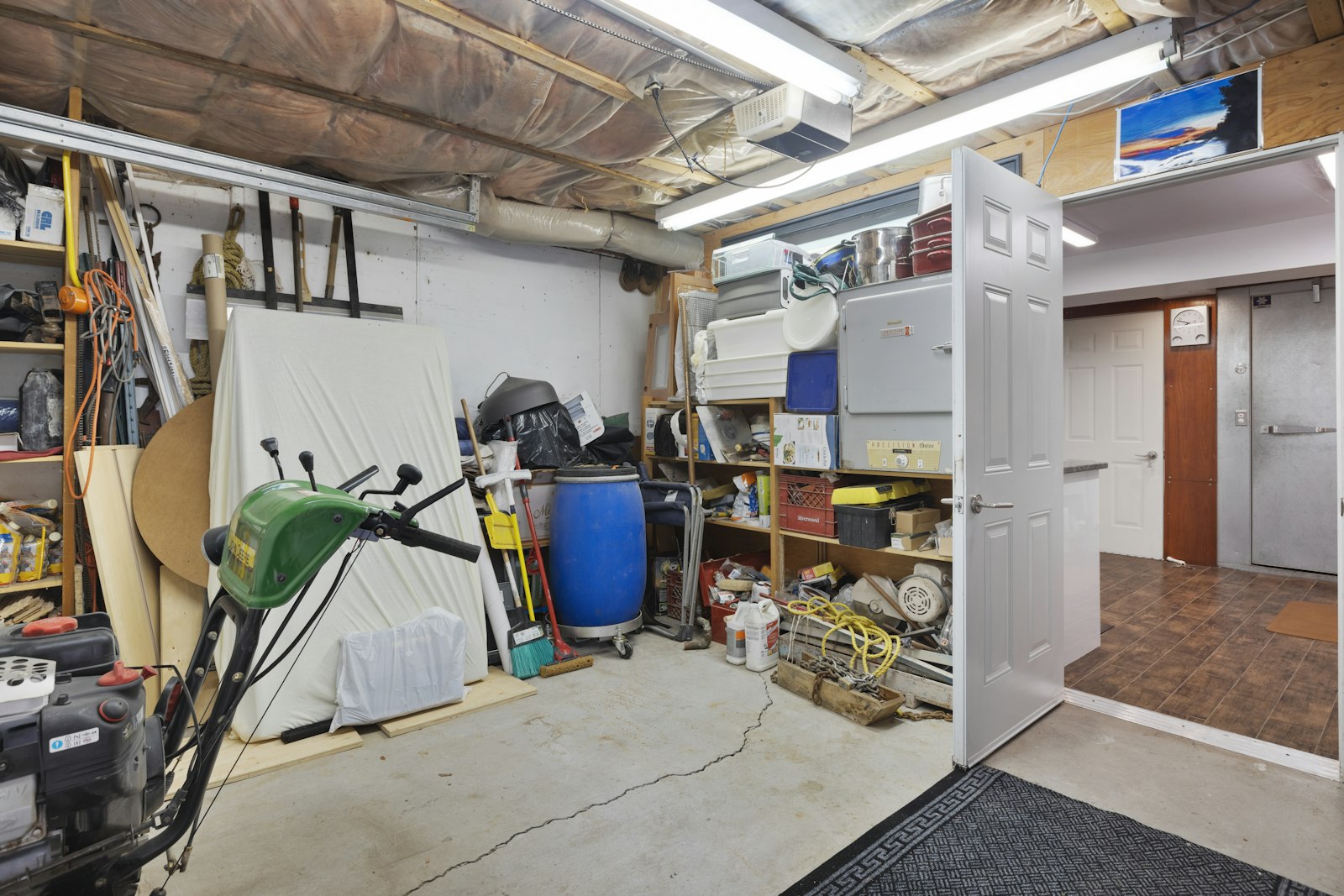
Quick answer: almost everyone underestimates how much they own, and the error is not random. It sits in specific places, principally the garage, the loft, the shed and the kitchen, because storage exists precisely to hide quantity. The fix is a written count that opens every cupboard, photographs sent to whoever is quoting, and roughly ten per cent added on top. Anything cleared before the survey never enters the price at all.
The living room went beautifully. Sofa out, television wrapped, bookcase emptied and carried, coffee table on its side against the bulkhead. Bedrooms after that, and by half ten the crew were well ahead of schedule and somebody had made a second round of tea.
Then the customer said, almost as an afterthought, that there was just the garage to do.
It is a sentence that changes the shape of a morning. Inside were two bikes, a workbench, four boxes of tiles left over from a bathroom, a lawnmower, a pressure washer, six tyres, a chest freezer nobody had mentioned, and enough camping equipment for a small expedition. None of it had appeared in the estimate, because when the customer pictured their move, they had pictured their house.
Why the Garage Is Always the Problem
People estimate by imagining rooms they live in. Garages, lofts and sheds are storage rather than living space, so they do not come to mind when picturing a move, and they are precisely the places where bulky items accumulate over years without anyone deciding to put them there.
Ask somebody to describe their house and they will walk you through the rooms in order. Living room, kitchen, bedrooms, bathroom. The mental tour stops at the internal doors, which is exactly where the difficult volume begins.
There is a second effect at work. A garage fills gradually, one abandoned decision at a time, and nothing ever announces itself as an addition. The tiles went in after the bathroom was finished. The tyres came off the previous car. The camping gear was used twice in 2019. No single item felt significant, and collectively they are half a van.
The same applies to the loft, which has the additional advantage of being invisible, and the shed, which is small enough that people assume its contents must also be small. They are not. Garden equipment is bulky by nature, and bulk is what fills vehicles.
Storage Exists to Hide Quantity
Cupboards, wardrobes and drawers are doing their job when you cannot see what is in them. That means the tidier and better organised a household is, the worse its estimate tends to be, because nothing is visible to prompt the count.
This surprises people, and it is one of the more reliable patterns in the work. Chaotic houses where everything is on show frequently produce better estimates than immaculate ones, simply because the occupants can see what they own.
The kitchen is the clearest example. It looks like one modest room and it produces more cartons than any bedroom in the house, because every cupboard is dense and nothing in it is visible until the doors are open. A useful rule when counting: one full kitchen cupboard is roughly one medium box.
Wardrobes work the same way. The wardrobe itself is a single item of furniture. What is inside it is a considerable number of boxes, plus everything on the shelf above, plus whatever is on the floor of it that has been there since you moved in.

The Count That Actually Works
Walk the house with a notebook, list furniture item by item, then estimate boxes room by room with every cupboard open. Include the loft, garage and shed as their own entries. Photograph as you go, and add about ten per cent at the end.
It takes about an hour and it is genuinely dull. It is also the difference between a quote that holds and a quote that changes on the day.
Furniture first, individually. Not bedroom furniture as a category, but each piece. Two bedside tables is two lines.
Boxes second, with the doors open. Count what will come out of the cupboards rather than what you can see standing in the room.
Then the spaces that broke the last estimate. Garage, loft, shed, under the stairs, under every bed, the airing cupboard, and anything you already have in storage somewhere else.
Photographs of all of it. This is the single most useful thing you can send a firm before they quote, and it takes five minutes. Include the open garage and the loft hatch.
Add ten per cent. Not because the count was careless, but because a house in the weeks before a move generates things rather than losing them.
If it helps to see what the vehicles themselves hold, our explainer on what a Luton van is and what it carries sets out the capacities.
What Goes Wrong When the Number Is Low
Usually a second trip, which costs hours and money on a local move and can push the job into the following day on a longer one. Overloading also causes damage, and weight limits are legal rather than negotiable, so a van can run out of permitted payload while still looking half empty. A standard car licence covers a vehicle up to 3,500kg maximum authorised mass, and that figure includes the driver, the fuel and everything in the back.
The worst version is the one nobody plans for: the load will not fit, the crew are waiting, and somebody has to stand in an empty hallway deciding what stays behind. That decision is unpleasant at any time and considerably worse at four o’clock after a long day.
There is also a quieter cost. When the volume is wrong, loading takes longer than planned, and the delay lands at the far end, where the keys arrived late anyway and everyone is already tired.
It is worth knowing how widespread the miscalculation is. Of more than 44,000 vans weighed at the roadside by the Driver and Vehicle Standards Agency (DVSA) since 2015, roughly 23 per cent were found to be overloaded. Nearly a quarter of professionally driven vehicles are carrying more than they should, which puts a household guessing at its own garage in reasonable company. Penalties are graduated by how far over the limit the vehicle is, starting at £100 and rising to a court summons past 30 per cent.
What Makes This Harder Across Manchester
Volume interacts with access, and access across Greater Manchester varies enormously. The same contents cost differently depending on whether the van can park outside, whether there is a lift, and whether the property is a terrace with an entry or a city-centre flat with a booked loading bay.
Terraced streets are the recurring one. Across Chorlton, Levenshulme, Withington and much of south Manchester, permit parking means the van may not be able to stop directly outside. Carrying distance is time, and time is priced.
City-centre apartments need arranging rather than turning up. Loading bays are frequently booked through building management, lifts sometimes need reserving, and some blocks restrict move times to particular hours. A large sofa also has to fit the lift, which is worth measuring rather than assuming.
Garages here are often not attached. Rear garages reached through an alley or a block of lock-ups mean a separate carry, sometimes a considerable one, and that changes the job even when the volume is identical.
Cellars are common in older Manchester housing, and they are the local equivalent of the loft. Damp, forgotten, full, and never mentioned until the day.
Anyone weighing up how a quote gets built will find our comparison of instant versus in-person removal quotes useful, since this is precisely the difference between the two.
What a Cubic Metre Looks Like, So the Numbers Mean Something
Removals is priced on volume, usually in cubic metres, and most people have no working sense of the unit. A cubic metre is a box a metre on each side, which is roughly a washing machine plus a bit. Around ten standard medium cartons stack into one.
That reference point makes everything else usable. Rough figures worth carrying in your head while counting:
| Item | Approx. volume (m³) | Equivalent in medium cartons |
|---|---|---|
| Three-seat sofa | 2.0 | About 20 |
| Double bed and mattress | 1.5 | About 15 |
| Double wardrobe | 1.5 | About 15 |
| Dining table with four chairs | 1.2 | About 12 |
| Chest of drawers | 0.6 | About 6 |
| Washing machine or fridge | 0.5 each | About 5 |
| One medium carton | 0.1 | 1 |
Total those for a fairly ordinary two-bedroom flat and you pass ten cubic metres before opening a single kitchen cupboard. That moment, when the arithmetic overtakes the instinct, is the whole point of doing it on paper.
It also explains why the sofa is such a useful test. One item, two cubic metres, roughly twenty boxes worth of space. Anyone who has watched a sofa go into a van and seen how much of it disappeared has already learned this lesson the practical way.
The Things That Change a Price Besides Volume
Two moves with identical contents can be quoted quite differently. Carrying distance, stairs, lift availability, dismantling and any unusually heavy single items all affect the time a job takes, and time is the second half of every quote.
Distance from the van to the door. Every metre is carried repeatedly across a whole day, so a van that parks outside is a materially shorter job than one parked round the corner.
Stairs and lifts. A third-floor flat with no lift is a different job from a ground-floor house holding the same contents. Where there is a lift, the question is whether the furniture fits it.
Dismantling and rebuilding. Beds, wardrobes and some flat-pack furniture need taking apart and putting back together, which is routine work but not free work.
Heavy or awkward single items. Pianos, safes, American fridges, gym equipment. None of these are excluded, they simply need the right crew and kit, which means mentioning them in advance.
When you are moving. Fridays, month ends and the summer are the busiest periods across the industry, and availability affects price.
None of that can be judged from a phone call describing a three-bedroom semi, which is the underlying case for a proper look at the property rather than a number generated in thirty seconds.
The Cheapest Way to Fix a High Number
When the count comes back bigger than expected, there are two options. Book a larger vehicle, which costs what it costs. Or move less, which costs nothing and reduces the price at the same time.
Removals is priced principally on volume, so anything disposed of before the survey never appears in the quote at all. It is the only preparation job that makes the move itself cheaper rather than merely easier, and it works best on exactly the spaces that broke the estimate. Our guide to what to do with the loft before you move covers the method, and the garage responds to the same approach.
Where things are worth keeping but the new place will not take them yet, self storage in Manchester bridges the gap. The honest caveat is that storage suits things you have decided to keep rather than decisions you would rather not make.
How We Handle This
Our surveys ask about the garage, the loft, the shed and the cellar by name, because those are the four that change the number and the four people forget. It is not an interrogation. It is the difference between a quote that survives contact with moving day and one that does not.
Worth saying plainly: a low quote built on a low estimate is not a saving. The volume is whatever it is, and finding out on the morning helps nobody. A survey that produces a slightly larger figure than you hoped is working correctly.
Our Manchester packing services also remove most of the uncertainty, since a crew packing your kitchen knows exactly how many cartons came out of it. House removals cover the move itself. Have a look at the Removals Company Manchester homepage or get a quote, and mention the garage first rather than last.
Where the Service Level Sits in the Estimate
Volume decides the vehicle. The service level decides the hours. Two households with identical cubic metres can be quoted differently because one is handing over the dismantling and the packing and the other is not, and hours are the second half of every price.
Knowing which level you are comparing matters when you are checking one quote against another, because the number on its own tells you very little.
| Level | What you keep | What we take on |
|---|---|---|
| Standard | All packing, and any dismantling | Loading and unloading the volume you counted |
| Standard Plus | The packing | Loading and unloading, plus taking every piece of furniture apart and rebuilding it at the other end |
| Premium | As little as you like | Dismantling and rebuilding, plus professional packing to whatever extent you ask for |
| Boxes only | Everything | Supplying cartons and materials, nothing more |
| Storage | The decision about what stays | Holding whatever the new place cannot take yet |
Premium is also the version that solves the counting problem outright, because a crew packing your kitchen produces an exact carton count rather than an estimate of one. If you would rather do the count yourself, the method above works perfectly well. See packing services and furniture dismantling for what each involves.
One external check worth doing regardless of who you book: the British Association of Removers maintains a directory of member firms, all of which are inspected annually and required to hold insurance or accept liability under their contract terms.
Questions People Ask About Estimating a Move
Why do people underestimate how much they own?
Because estimating happens by picturing rooms, and storage spaces are not rooms anyone pictures. Garages, lofts and sheds sit outside the mental tour of a house, and cupboards are designed to conceal quantity. Well-organised households often estimate worst, because nothing is visible to prompt the count.
Is booking by number of bedrooms accurate enough?
It is a starting point rather than an answer. Two identical three-bedroom houses can differ by half a van depending on whether there is a garage, a loft, a cellar and how long the household has been there. An itemised list is considerably more reliable.
What should I photograph before getting a quote?
Every room, plus the open garage, the loft hatch, the shed and the cellar if you have one. Photographs are the fastest way to give a firm an accurate picture and they take about five minutes. Show the full spaces rather than the tidy corners.
What happens if the van is too small on the day?
Usually a second trip, costing hours and additional charges, and on longer moves the job may not finish that day. Occasionally it means choosing what stays behind while a crew waits, which is the worst possible moment for that decision.
Can a van be full by weight rather than space?
Yes, and it is a legal limit rather than a preference. Books, tools, tinned food and gym equipment are dense enough to reach the payload limit while the van still looks half empty. Mention anything unusually heavy when you get quoted.
Does clearing things out actually lower the price?
Yes, provided it happens before the survey rather than after. Removals is priced principally on volume, so anything gone by then never enters the calculation. It is the only job in a move that reduces the cost of the move itself.
Does parking affect what a move costs in Manchester?
Considerably. Carrying distance is time and time is priced, so a van that cannot stop outside makes the same contents a longer job. Permit streets, city-centre loading bays and rear garages reached through an alley all change the picture.