
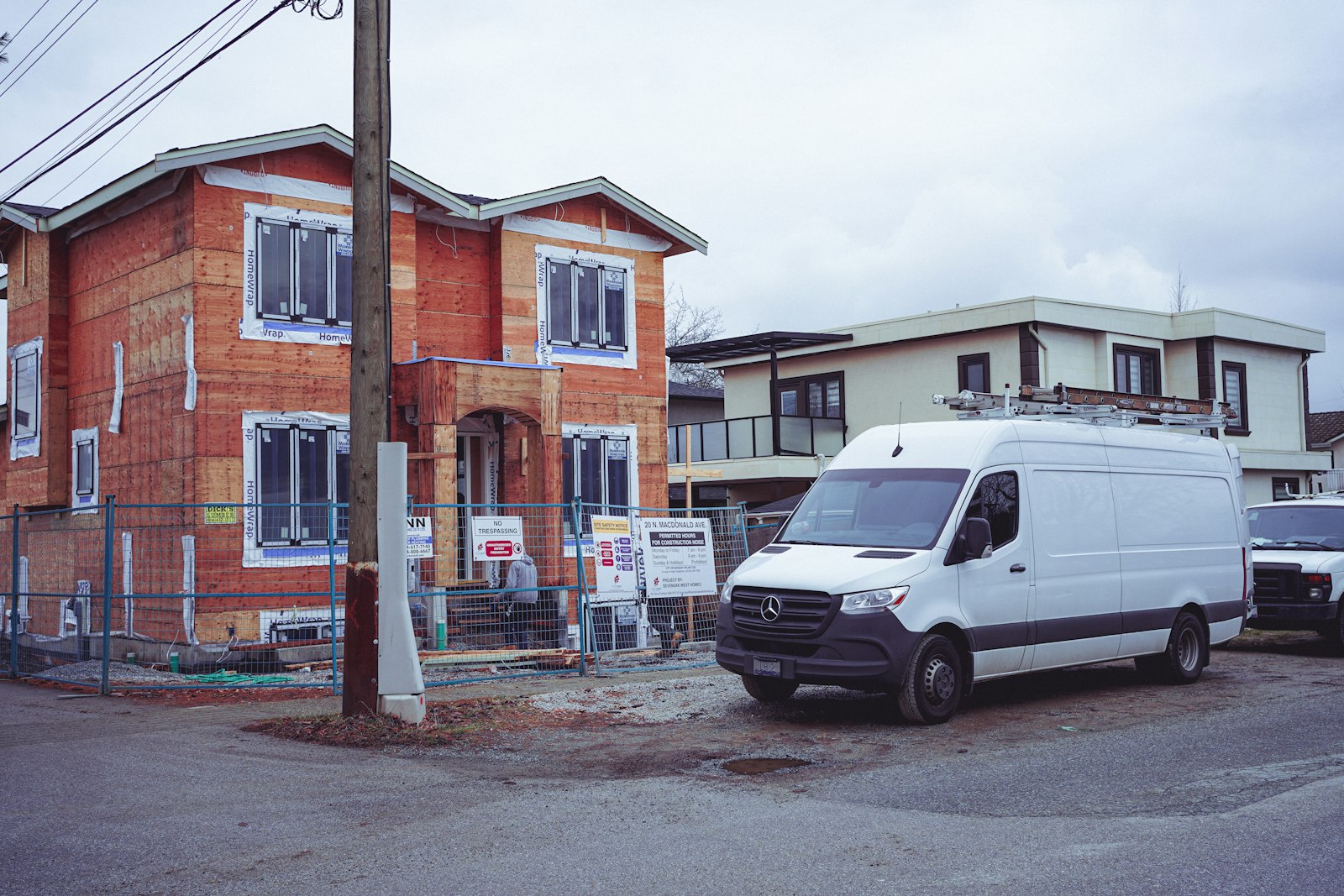
Quick answer: parking is the most common reason a move starts badly, and it is entirely solvable in advance and almost unsolvable on the morning. Loading exemptions are short, and Manchester City Council advises applying for a dispensation once loading is likely to run beyond an hour, which every house move does. Cones and wheelie bins reserve nothing legally. A suspension holds the space, a dispensation only permits the vehicle to stand somewhere restricted. Both need arranging at both addresses, in working days, before the date arrives.
Eight o’clock on a Friday in Levenshulme. The crew are early, the weather is behaving, and the customer has done everything properly: packed to schedule, labelled by room, loft cleared a fortnight ago.
The street, however, is full.
Not unusually full. Ordinarily full, in the way a terraced street with permit parking is full at eight on a weekday, because everybody who lives there is still at home. There is no space outside the house. There is no space four doors down. There is a gap of sorts about seventy metres away, opposite the corner shop, which is where the van ends up.
Nobody did anything wrong. It simply never occurred to anyone that the space itself needed arranging, and by eight o’clock on the day there is nothing anybody can do about it.
Why This Is the Problem Nobody Plans For
Parking sits in a gap. Customers assume the removals firm handles it, firms often expect the customer to, and neither finds out until the vehicle arrives. It is also the only part of a move where preparation has to happen days in advance through a third party with its own timetable.
Everything else about a move responds to effort on the day. Pack faster, carry more, start earlier. Parking does not work like that. The council needs notice, and notice cannot be applied retrospectively at eight in the morning while a crew stands about.
There is a second reason it gets missed. People think about the property, not the street. The survey covers what is in the house, the quote covers what it costs to move, and the kerb outside is nobody’s explicit responsibility unless somebody raises it.
The Thirty Minute Assumption
Most people believe that because they are loading, they are permitted to be there. Loading exemptions are real but short. Manchester City Council advises requesting a dispensation once loading or unloading is likely to take longer than an hour, or where the goods make it unlikely the driver returns to the vehicle promptly. The Highway Code rules on waiting and parking set out where you cannot stop at all, whatever you are carrying.
A house move takes a working day. Even a one-bedroom flat rarely loads in under ninety minutes once the stairs are involved. The exemption everybody quietly relies on has expired long before the wardrobe comes out.
It also requires the loading to be genuinely continuous. A vehicle standing on a yellow line while people go up and down stairs for three hours is not what the exemption describes, however busy everyone involved obviously is.
And it does not apply everywhere. Bus stops, cycle lanes, dropped kerbs and junctions are off limits regardless of what is being carried.

Two Different Things, Frequently Confused
A suspension takes named bays out of use, with council signage installed in advance, so the space is reserved and enforceable. A dispensation permits a specific vehicle to stand somewhere it normally could not, such as a single yellow, but reserves nothing at all.
This distinction decides whether your van gets near the door, and almost no consumer advice explains it. In Manchester both are chargeable and both need warning: the council lists a bay suspension at £30 per day per bay and a yellow line dispensation at £30 per vehicle per day, with a minimum of five working days notice on any application. Domestic removals are named on that page as an accepted reason, so this is a routine request rather than a special favour.
A suspension is what you want on a busy residential street. Somewhere the difficulty is competition for space rather than restriction. It costs more and takes longer to arrange, because the council has to produce and install the signs.
A dispensation suits a street where there is somewhere to stand but it is restricted. It solves the legality and leaves the availability to chance.
Applying for the wrong one is a specific and disappointing failure: you have paid, you have the paperwork, and there is still a Corsa parked exactly where the van needed to be.
What This Looks Like Across Greater Manchester
Requirements differ by borough, so the address matters more than the city. Manchester, Salford, Trafford, Stockport, Tameside and the rest each run their own parking operations with their own forms, fees and notice periods.
Terraced streets with permit parking are the classic difficulty. Across Chorlton, Levenshulme, Withington, Fallowfield and much of the inner south, every space is occupied by somebody who lives there, and a van needs two of them.
Rear entries are not a solution. The alley behind a terrace is usually too narrow for a removal vehicle, frequently gated, and often shared. Where it works it is excellent, and it is worth checking rather than assuming.
City-centre apartments have a separate system entirely. Loading bays are commonly booked through building management rather than the council, lifts sometimes need reserving, and some blocks restrict move times to certain hours. That is a phone call to the building, not to the local authority, and it needs making early.
Student changeover weeks make everything harder. Late August and September around the university corridor put enormous pressure on kerb space, and that is precisely when a large share of moves happen.
Check which borough you are actually in. Boundaries do not follow postal addresses, and a Manchester postcode does not guarantee Manchester City Council. Applying to the wrong authority wastes days you may not have.
The practical step is to give whoever is quoting the exact street address as early as possible, so the zone can be checked while there is still time to act. Our guide to instant versus in-person removal quotes explains why this sort of detail is the difference between the two.
How Many Bays a Van Actually Needs
More than people assume. A single removal vehicle generally needs two standard bays, and two vehicles need around three, which is roughly fifteen metres of kerb. Applying for one bay and hoping is a common and expensive miscalculation.
The reason is straightforward once you picture it. A Luton is considerably longer than a car, and the tail lift needs clear space behind it to lower and operate. A vehicle wedged into a single bay cannot open properly, which defeats the point of having the space at all.
It is also worth thinking about where those bays sit. Two bays directly outside the property beat three bays fifty metres along the street, because the carry is what costs time. If the choice is between a longer stretch further away and a shorter one outside the door, take the door.
One more thing that catches people out: height. Overhanging branches, low signage and the scaffolding somebody put up two doors down all stop a high vehicle from getting where the paperwork says it may go. A quick look upwards when you check the street saves a genuinely frustrating conversation.
The Cones Question
Cones, wheelie bins and a hopefully positioned garden chair reserve nothing. Highway space can only be reserved with council authorisation, and unauthorised objects can be removed by enforcement officers.
Every street has somebody who has tried this, and it fails in a particular way. Another driver moves the bin, parks entirely legally, and there is no mechanism to have them shifted because no restriction exists. The bin was never the law.
Parking your own car in the space overnight is marginally better and still awkward. It holds one space, a van needs two, and you have to move it at exactly the moment everything else is happening.
The one genuinely effective informal measure is talking to your neighbours. A quiet word a few days beforehand costs nothing, and most people will happily leave a gap or move a car for an hour. It is not enforceable and it works surprisingly often.
What It Costs When Nobody Sorts It
Chiefly time, which is priced. Removals is charged on the length of the job as well as the volume, so a long carry makes the same contents a longer and more expensive move.
Seventy metres does not sound like much until you multiply it by every box, every chair and every trip back. On a full house that is several additional hours across the day, and the delay compounds at the far end where the unloading then runs late.
There is also the penalty risk, and it is a specific number rather than a vague threat. Manchester grades parking in a suspended bay as a higher level contravention at £70, which is a memorable way to discover that somebody else booked the space you assumed was free. Who pays depends on your contract with the firm, and it is worth knowing the answer before the day rather than afterwards.
And there is the neighbourly cost, which is real if unmeasurable. A van blocking a narrow terraced street for six unannounced hours is a poor way to introduce yourself to people you are leaving, or worse, to people you have just moved in beside.
What to Do, and When
Start the moment your date is confirmed. Identify the restrictions on both streets, work out whether you need a suspension or a dispensation, confirm who is applying, and allow for notice periods stated in working days.
Read the street. Controlled parking zone signs at the entrances give the restricted hours. The small plates beside the bays tell you what each bay is and when its rules apply. Kerb markings indicate loading restrictions separately from the lines.
Check the right council’s parking pages. Fees, forms and notice periods are set locally and revised regularly, commonly each April, so use current council information rather than anything you read in an article.
Settle who applies. Some firms do it, some councils require the vehicle operator to, and some expect the resident. Agree it at quote stage and get it in writing.
Gather what the form needs. Usually the address, the date, start and finish times, the vehicle registration and often its dimensions. Your removals firm holds most of that.
Do both ends. Two addresses, two councils, two applications. Unloading is the half where a long carry hurts most, because it happens when everyone is already tired.
Look up. Low branches, overhanging signs and anything else that stops a high vehicle are worth checking before the day, not on it.
How We Handle It
Access is assessed at survey stage at both properties, because where the van stops affects the length of the day as much as the contents do. Where a street is controlled, that gets flagged while there is still time to arrange something.
We can provide the vehicle registration, dimensions and realistic timings any application needs, and tell you how many bays the job actually requires, which is usually two and occasionally three. What we cannot do is create parking on the morning, which is why the address is worth sending as early as you have it.
Our Manchester packing services also reduce the time the vehicle needs to be on the kerb, which matters when a bay is booked by the day. House removals cover the move itself, and there is more on how quotes get built in our piece on why people underestimate how much they have to move. Browse the Removals Company Manchester homepage or get a quote, and mention the street.
How the Service You Book Changes the Kerb Problem
A bay is booked by the day, so anything that shortens the time the vehicle spends at the kerb reduces both the cost and the risk of running past the hours you paid for. That is the practical reason the service level matters here, rather than any question of comfort.
Put crudely, the more that is ready when the crew arrive, the less kerb time you buy.
- Standard
- Loading and unloading only. The vehicle waits at the kerb for as long as it takes you to have been ready, which on a suspended bay is a meter running in the background.
- Standard Plus
- Furniture comes apart and goes back together as part of the job. Worth knowing on a narrow terraced street, because a wardrobe that has to be dismantled in the doorway blocks the pavement while it happens.
- Premium
- Packing done to the extent you want it, so nothing is still going into boxes while a booked bay ticks away outside. The version that best protects a fixed loading window in a city-centre block.
- Boxes supplied
- Cartons delivered in advance. Cheapest way to make sure the load is genuinely stackable when the tail lift comes down, which is what determines how fast a van fills.
- Storage
- Useful when the kerb problem is really a date problem, and the load needs somewhere to sit between two addresses that could not be booked on the same day.
See packing services, furniture dismantling and self storage for the detail, or man and van where a smaller vehicle needs only one bay rather than two.
Questions People Ask About Removals Parking
Can the removal van just park on a yellow line while loading?
Only briefly. Loading exemptions are short and conditional, and Manchester City Council advises requesting a dispensation once loading is likely to run beyond an hour, which a house move always does. They also do not apply where kerb markings show a loading restriction, or at bus stops, dropped kerbs and cycle lanes.
What is the difference between a suspension and a dispensation?
A suspension takes named bays out of use with council signage, so the space is reserved and enforceable. A dispensation lets a specific vehicle stand somewhere restricted without a penalty but reserves nothing, so another driver can still take the spot.
Can I put cones out to save a space?
No. Reserving highway space needs council authorisation, and unauthorised cones or bins can be removed by enforcement officers. Anyone who parks there is doing nothing wrong and cannot be made to move.
How far ahead should I sort parking in Manchester?
As soon as your date is confirmed. Manchester requires a minimum of five working days on any application and charges £30 per day per bay, so a bank holiday quietly removes several days of that window. Other boroughs set their own fees and notice periods, and suspensions take longer than dispensations because signage has to be produced and installed.
Does my removals company arrange the parking?
It varies, and some councils require the application to come from whoever operates the vehicle. Agree it at quote stage and get the answer in writing, because both sides assuming the other has done it is the usual failure.
Do I need to arrange it at the new address too?
Usually yes, and it is a separate application to whichever council covers that address. Unloading is the half of the day where a long carry costs most, since it lands when the crew and the household are already tired.
What if the property is a city-centre flat?
The loading bay is often controlled by building management rather than the council, and may need booking along with the lift. Some blocks also restrict move times. That is a call to the building, and it needs making well before the day.